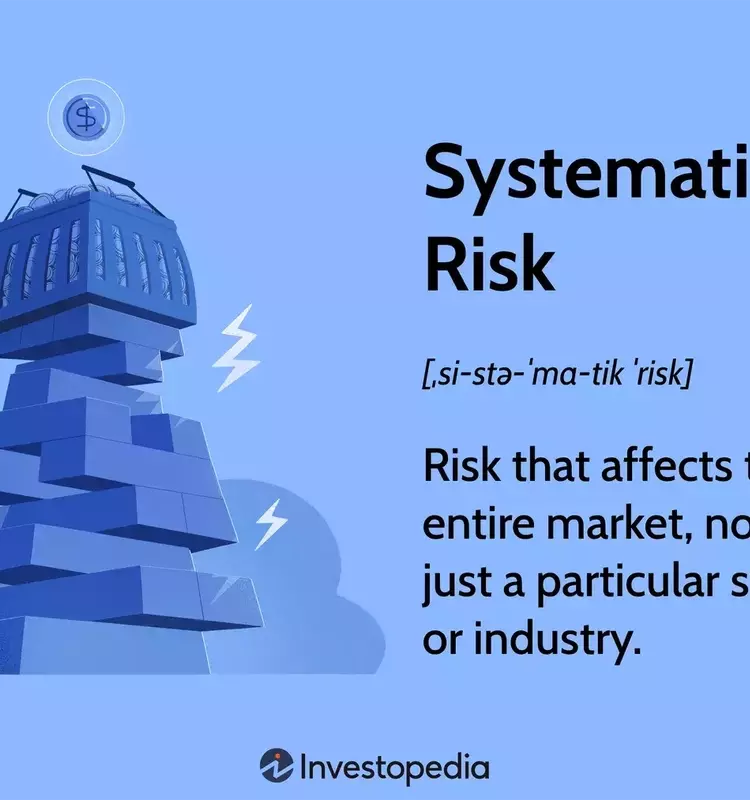
Systemic risk, often termed market risk, is an inherent aspect of the financial landscape that impacts the entire market or significant segments thereof. This pervasive risk is driven by broad macroeconomic factors such as inflationary pressures, economic downturns, and shifts in interest rates. While investors cannot entirely escape systemic risk through simple diversification, strategic asset allocation across diverse classes and careful hedging can help mitigate its potential impact. This article delves into the nature of systemic risk, differentiates it from unsystematic risk, provides practical examples, and offers insights into effective management strategies.
Systemic risk is a fundamental characteristic of financial markets, meaning it affects all investments to some degree and cannot be entirely nullified through traditional diversification within a single asset class. Instead, its impact on a portfolio must be addressed by employing advanced strategies such as hedging or by carefully structuring asset allocation to include a broad spectrum of investment types. This approach acknowledges that while specific company or industry-related risks can be offset by diversifying within a portfolio, overarching economic events will inevitably influence the entire market, making systemic risk a critical consideration for all investors.
To effectively manage systemic risk, investors are encouraged to construct portfolios that include a variety of asset classes. This could encompass traditional equities, fixed-income securities, cash equivalents, and real estate. Each of these asset types responds uniquely to macroeconomic changes. For instance, an increase in interest rates might diminish the value of certain stocks as companies face higher borrowing costs, while simultaneously increasing the attractiveness of newly issued bonds due to their higher yields. Therefore, a well-diversified portfolio that includes income-generating assets can help balance potential losses in other areas during periods of rising interest rates, thereby cushioning the overall impact of systemic market movements.
Understanding the distinction between systemic and unsystematic risk is crucial for informed investment decisions. Unsystematic risk, in contrast to systemic risk, pertains to the specific risks associated with individual securities or a narrow group of assets, such as a particular company's operational issues or a specific industry downturn. This type of risk can be significantly reduced through diversification within a portfolio. On the other hand, systemic risk reflects the broader market's susceptibility to economic shifts. Investors often use the beta coefficient to quantify an investment's sensitivity to systemic risk. A beta value greater than one suggests higher volatility and more systemic risk relative to the overall market, while a value less than one indicates lower volatility. A beta of exactly one implies that the investment moves in tandem with the market's systemic risk levels.
The global financial crisis of 2008, widely known as the Great Recession, serves as a stark illustration of systemic risk. During this period, the values of investments across the market experienced significant declines, irrespective of individual company performance. The crisis demonstrated how different asset classes reacted divergently; highly leveraged and riskier securities faced massive sell-offs, whereas more conservative assets, such as U.S. Treasury bonds, saw their values appreciate. This event underscored the importance for investors to anticipate and prepare for broad economic disruptions that can impact their entire portfolio, emphasizing the need for robust risk management strategies beyond simple diversification.
Systemic risk, which encompasses risks inherent to the entire market or economy rather than isolated to individual companies or industries, is a constant presence in financial dealings. Factors such as inflation, economic downturns, geopolitical conflicts, interest rate adjustments, currency fluctuations, and natural disasters can all contribute to this pervasive form of risk. While complete elimination of systemic risk is unattainable, astute investors can employ various strategies to mitigate its effects. These include judicious asset allocation and comprehensive risk management frameworks, which are essential for navigating the unpredictable currents of the global financial markets.
