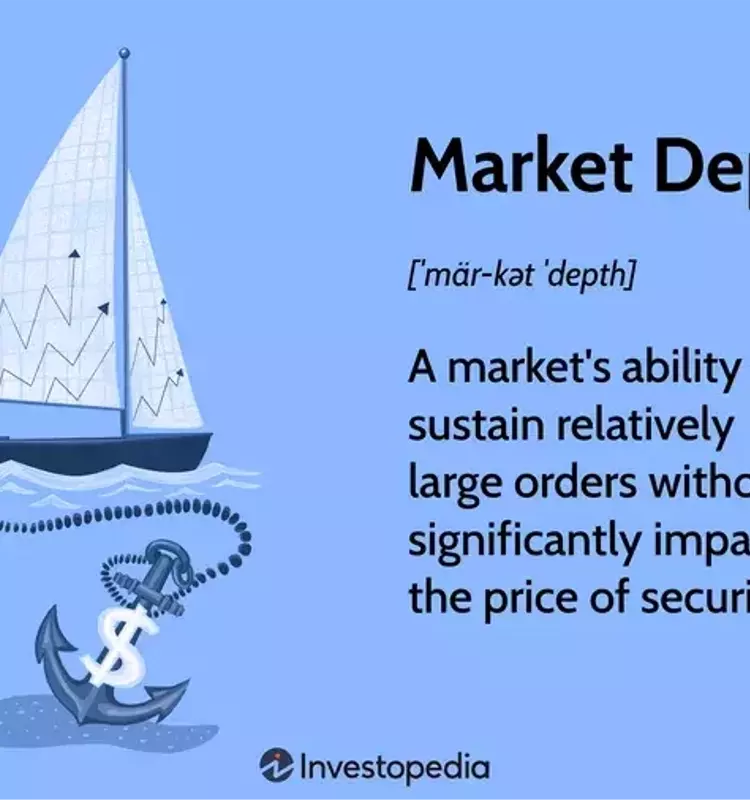
Understanding Market Depth: Key to Stable Trading
Finance

Understanding Market Depth: Key to Stable Trading

authorBy Michele Ferrero
DateJul 29, 2026
Read time3 min
Market depth is a crucial metric for understanding how resilient a financial market is to large trades. It reveals the extent to which a security can absorb significant buy or sell orders without undergoing substantial price changes, acting as a barometer for market liquidity. This article delves into the concept of market depth, its implications for trading, and how traders leverage this data for informed decision-making.

Navigating Market Dynamics: The Power of Depth

What Constitutes Market Depth in Financial Markets?

Market depth provides a snapshot of available buy and sell orders for a specific asset across various price levels. This indicator is vital for investors seeking to understand the ease with which a security can be traded without provoking major price shifts. A robust market depth signifies ample liquidity, where large trades can be executed with minimal disruption to prices. Conversely, shallow market depth suggests that even moderately sized orders can trigger considerable price swings.

The Impact of Market Depth on Trading Strategies

While often associated with trading volume and liquidity, market depth, also known as Depth of Market (DOM), offers a distinct perspective. It's not merely about high trading volumes but rather the distribution of orders within a security's order book. This book, a compilation of pending buy and sell orders at different price points, allows traders to gauge the market's immediate capacity to absorb trades. Even high-volume stocks can experience significant volatility if their market depth is uneven, reflecting order imbalances that can lead to abrupt price movements.

Harnessing Market Depth Data for Trading Success

Market depth data serves as a predictive tool for traders, offering clues about potential price trajectories. By analyzing the bid-ask spread and the concentration of orders at various price levels, traders can anticipate market reactions. Securities characterized by deep markets and high liquidity enable traders to execute large orders without unduly influencing the market price. In contrast, thinly traded securities with poor market depth are susceptible to substantial price movements from even modest buy or sell orders.

Market Depth in Practice: A Visual Illustration

Consider a hypothetical order book for "MEOW" shares. If the current price range is $13.62 (bid) to $13.68 (ask), with 3,000 shares at the bid and 500 at the ask, the depth of bids on the right panel provides further insight. If a large sell order of 10,000 shares is placed, it would consume all available bids down to $13.35, where a significant buy order for 43,500 shares resides. This scenario would cause the market price to drop by nearly 30 cents, or approximately 2%, demonstrating a low level of market depth. Such real-time data, often provided by trading platforms, empowers traders to capitalize on short-term price fluctuations, particularly when a company experiences significant events like an initial public offering, by identifying strong buying demand that could propel prices upward.

More Articles
Finance
MENA Region: Economic Landscape and Geopolitical Dynamics
The Middle East and North Africa (MENA) region encompasses a diverse group of countries, playing a pivotal role in global energy and economic stability. Rich in oil and natural gas, it faces significant geopolitical challenges. This article explores the region's key economic players, investment opportunities, and the impact of ongoing conflicts on its development and market volatility.
By Mariana MazzucatoJul 29, 2026
Finance
McCormick & Company: A Buy Rating Reaffirmed Amidst Growth and Strategic Acquisitions
McCormick & Company (MKC) maintains its Buy rating following strong Q2 results, propelled by a 16.9% year-over-year revenue increase. This growth is attributed to the acquisition of McCormick de Mexico and strategic organic pricing. The company reaffirms its 2026 guidance, forecasting substantial sales and margin expansion. Despite potential risks like increased leverage post-acquisition and competition from private labels, McCormick's intrinsic value is projected to rise above current levels, supported by macroeconomic improvements and synergistic benefits from recent deals, suggesting a re-rating potential.
By Morgan HouselJul 29, 2026
Finance
Meta Platforms: A Deep Dive into Growth and Valuation Potential
Meta Platforms (META) continues to be a robust investment, projected to reach an $815 price target, offering nearly 50% upside post-earnings. Its advertising sector is thriving, with significant increases in revenue, impressions, and ad prices. Despite substantial AI investments impacting free cash flow, the underlying financial health remains strong, suggesting current market skepticism offers a unique buying opportunity.
By Mariana MazzucatoJul 29, 2026
Finance
Meta Platforms: Navigating Post-Earnings Volatility and Long-Term Value
Meta Platforms (META) experienced an 8% stock decline post-earnings despite strong operational metrics and revenue growth, signaling a mixed market reaction to its Q2 results. Elevated R&D, legal, and severance costs led to margin compression, but the core business and user expansion remain robust. While Q3 revenue guidance is below consensus and CapEx pressures free cash flow, significant monetization opportunities persist. With a 2026 P/E of 16.9x and nearly 6% earnings yield, META presents an attractive long-term investment.
By Fareed ZakariaJul 29, 2026
Finance
Centerra Gold: Strong Performance and Strategic North American Focus Underpins 'Strong Buy' Rating
Centerra Gold maintains a 'Strong Buy' rating due to its significant undervaluation, robust operational advancements, and strategic pivot towards North American assets. The company reported a 53.6% year-over-year revenue increase in Q2, boosted gold production guidance, and is heavily investing in its North American operations. With no long-term debt, substantial cash reserves, and ongoing share buybacks, CGAU is well-positioned for growth and shareholder returns. Its intrinsic value is estimated to be considerably higher than its current market price, suggesting the market is underestimating its potential as the North American strategy progresses.
By David RubensteinJul 29, 2026