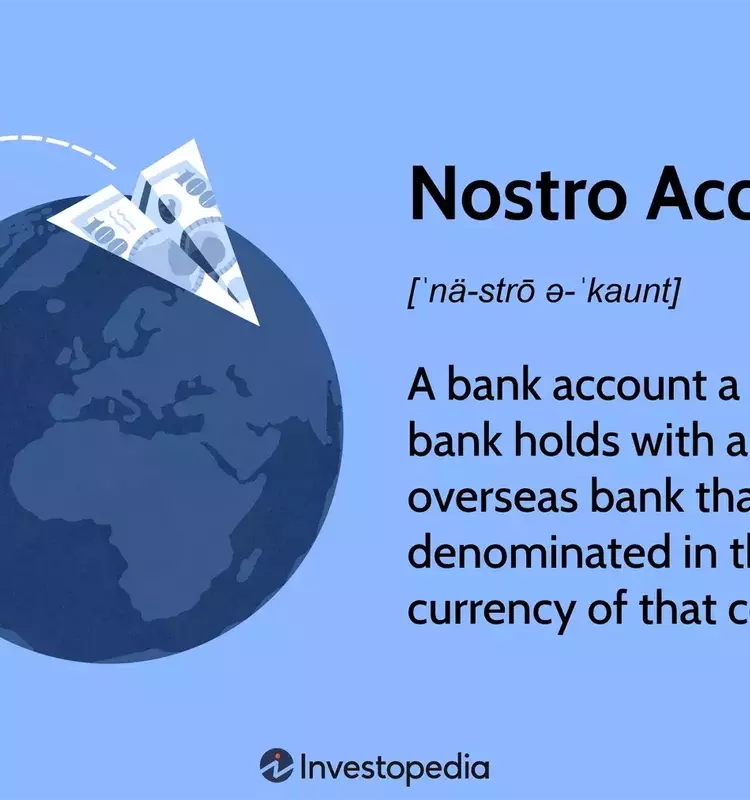
Nostro accounts are indispensable tools in the realm of global finance, providing domestic banks with the ability to maintain accounts in foreign currencies within other nations. These specialized accounts streamline foreign exchange operations and international trade, making currency conversion and settlement processes more efficient. It is important to distinguish nostro accounts from their counterparts, vostro accounts, which represent funds held by foreign entities in a domestic bank's currency.
The operational framework of nostro accounts centers on their role in facilitating cross-border financial activities. A singular account can be classified as both a nostro and a vostro, depending on the perspective of the transacting banks. For instance, if Bank A maintains an account with Bank B denominated in Bank B's local currency, Bank A views this as a nostro account, signifying 'our account held by your institution.' Conversely, Bank B considers this same account a vostro account, meaning 'your institution's account held by us.' These accounts are instrumental in settling international transactions and serve as a mechanism to hedge against fluctuations in exchange rates. Historically, before the introduction of the euro on January 1, 1999, banks required separate nostro accounts for each country now within the eurozone. Following the euro's adoption, a single nostro account sufficed for the entire eurozone. However, should any nation depart from the eurozone, banks would need to reactivate or establish new nostro accounts in that country's new currency to continue facilitating payments. Globally, most major commercial banks hold nostro accounts in every country that utilizes a freely convertible currency.
These specialized financial instruments are subject to administrative fees, which can be substantial due to the unique functionalities they offer. As a result, nostro accounts are not accessible to individual clients; rather, they are exclusively utilized by businesses and governmental entities involved in international commerce and finance. Furthermore, in nations where central banks impose restrictions on currency trading to manage imports, exports, and exchange rates, nostro accounts are less common. In such scenarios, banks often rely on correspondent banking relationships to execute transactions in countries where they do not hold their own nostro accounts. These accounts play a vital role in simplifying global financial interactions, helping to manage risks associated with currency fluctuations, and are typically denominated in major international currencies such as the U.S. dollar, euro, and Japanese yen.
Nostro accounts are a cornerstone of modern international banking, enabling seamless foreign exchange and trade. By allowing banks to manage foreign currency holdings in other countries, they simplify complex cross-border transactions and help mitigate currency risk. While similar to traditional demand deposit accounts, their distinct feature of holding foreign currency and their exclusive use by institutions underscore their specialized function in the global financial ecosystem. These accounts embody precision and interconnectedness, fostering a dynamic and efficient global financial environment.
