Understanding Operating Income: Key Metrics for Business Performance
Finance

Understanding Operating Income: Key Metrics for Business Performance

authorBy Robert Kiyosaki
DateApr 29, 2026
Read time2 min

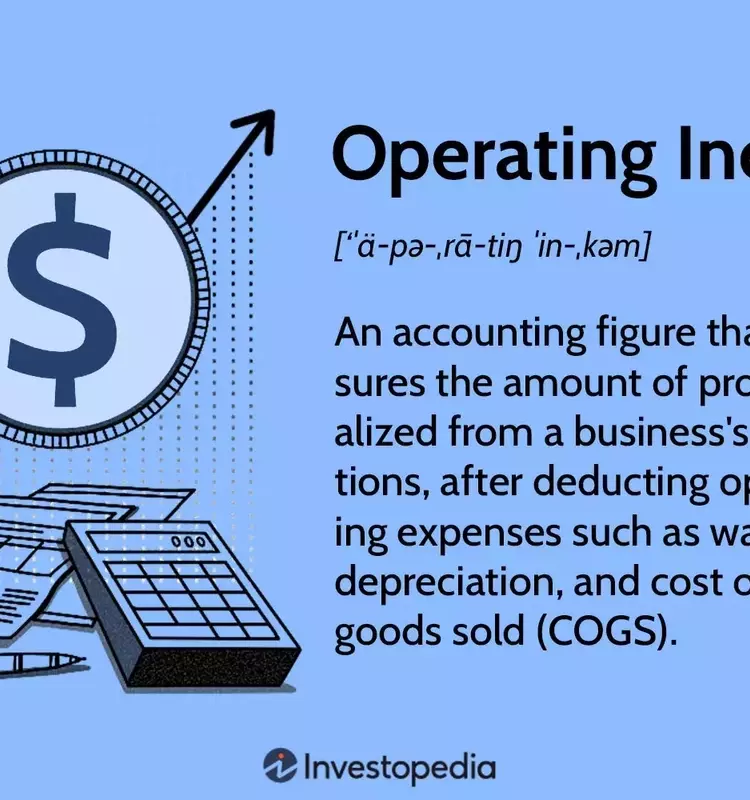
Operating income stands as a pivotal financial indicator, shedding light on a company's profitability derived solely from its core business operations. This metric encompasses all expenses directly tied to running the business, such as wages, depreciation, and the cost of goods sold, while intentionally excluding non-operating income, specific expenses, taxes, and interest payments. By focusing on these core elements, operating income provides a clear and unfiltered view of how efficiently a company transforms its revenue into profit through its primary activities. It is an invaluable tool for investors and management alike, offering insights into a company's operational health and its capacity to generate sustainable earnings.

Operating Income: Deep Dive into Calculation and Significance

In the financial realm, operating income is a central figure in assessing a company's operational efficiency. It represents the earnings remaining after deducting all direct costs associated with producing and selling goods or services, along with general administrative and selling expenses. This figure is critical because it isolates the profitability of a company's primary business model, free from the influence of external financial activities or extraordinary events. For instance, in the dynamic global market, Apple Inc. consistently demonstrates robust operating income. For the three-month period ending March 29, 2025, Apple reported an impressive operating income of $29.589 billion, a notable increase from $27.900 billion in the corresponding period of the previous year. This growth highlights the company's strong performance in its core product and service offerings, alongside effective cost management despite rising operating expenses, which increased from $14.371 billion to $15.278 billion. This financial data, readily available in the company's annual reports, showcases the importance of operating income as a barometer of business health and strategic effectiveness.

The measurement of operating income provides profound insights into a company's fundamental ability to generate earnings from its regular operations. This metric is a cornerstone for strategic decision-making and performance evaluation. Observing trends in operating income allows stakeholders to gauge the effectiveness of a company's operational strategies and its capacity for sustained profitability. It underscores the importance of efficient resource allocation and cost control, serving as a powerful indicator of a business's intrinsic value and potential for long-term success.

More Articles
Finance
Nacha: Revolutionizing Electronic Payments in the US
Nacha is a non-profit organization that manages the Automated Clearing House (ACH) network, facilitating electronic financial transactions between US bank accounts. It sets the rules and standards for money transfers and is funded by the financial institutions using its network. Nacha plays a crucial role in modernizing payment technologies, ensuring transaction security, and promoting faster payment initiatives, thereby shaping the future of digital finance.
By Strive MasiyiwaApr 29, 2026
Finance
Understanding Research & Development Expenses: A Comprehensive Guide
This article explores Research and Development (R&D) expenses, defining them as financial resources companies allocate to innovation and product improvement. It delves into the impact of R&D on business growth and competitiveness, details the accounting treatments under GAAP, and provides an example of Meta's R&D investments. The article also touches on the tax deductibility of R&D costs and the different types of R&D.
By Mariana MazzucatoApr 29, 2026
Finance
Federal Reserve's Consistent Stance on Interest Rates
The recent Federal Open Market Committee (FOMC) meetings have consistently maintained existing interest rate policies. Federal Reserve Chair Jerome Powell's commentary has largely echoed previous statements, with minimal adjustments. The market widely anticipated no changes to the benchmark interest rates, and the key focus was on whether Powell would continue his role after his term concluded. His decision to remain as a governor could potentially lead to more contentious discussions within the Fed in the future.
By Nouriel RoubiniApr 29, 2026
Finance
AMD: Riding the AI Wave with CPU Innovation
AMD is poised to capitalize on the AI-driven CPU revolution with its powerful EPYC CPUs and MI400 accelerators, projecting strong Q1 revenue growth and potential for exceeding EPS expectations. Despite a high P/E ratio, the company's long-term growth prospects, margin expansion, and multi-year backlog suggest its valuation is justified.
By Fareed ZakariaApr 29, 2026
Finance
Understanding Public-Private Partnerships: A Comprehensive Guide
Public-Private Partnerships (PPPs) are collaborations between government bodies and private companies to finance, construct, and operate large-scale projects. This approach allows governments to undertake essential infrastructure and service initiatives by leveraging private sector resources and expertise. PPPs involve negotiated risk-sharing, where the public sector typically manages regulatory risks, while the private sector handles construction and operational risks. They are commonly seen in transportation, environmental infrastructure, and public services, offering both advantages in efficiency and potential challenges in accountability.
By David RubensteinApr 29, 2026