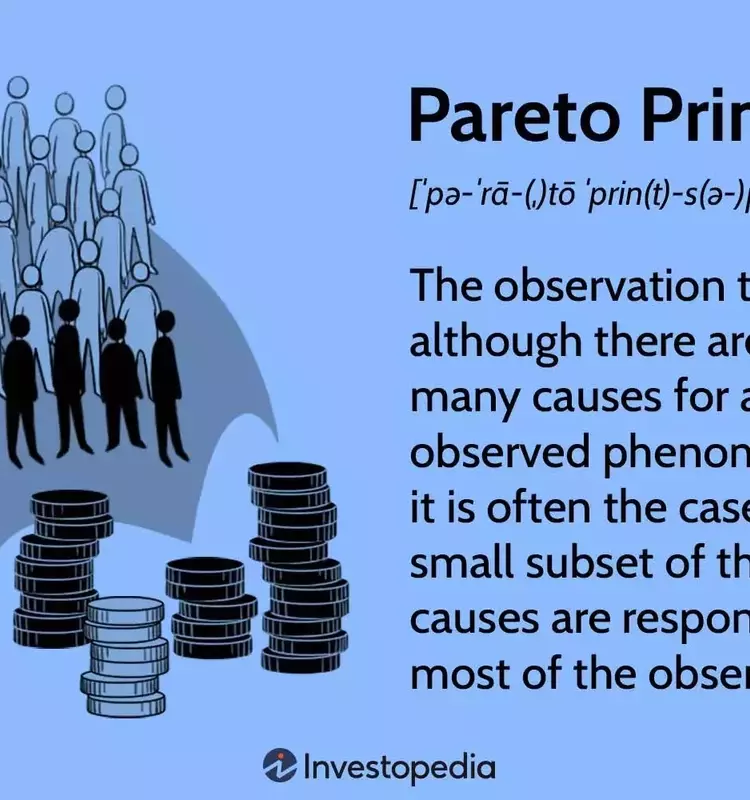
The Pareto Principle, often termed the 80/20 Rule, is an empirical observation highlighting that a disproportionate relationship exists between inputs and outputs. Specifically, it suggests that roughly 80% of consequences arise from just 20% of the causes. This principle, which originated from an insight into wealth distribution, has since become a cornerstone in various domains for enhancing productivity and decision-making.
The Core of the 80/20 Rule: Origins, Applications, and Implications
In the year 1906, Vilfredo Pareto, an Italian economist and sociologist, first noted this intriguing imbalance. His initial observation revealed that about 80% of Italy's land was owned by only 20% of its population. Further investigation across other nations corroborated this pattern, leading him to conclude that many aspects of life do not follow an even distribution. Decades later, in the 1940s, management consultant Joseph M. Juran formally named this phenomenon the Pareto Principle, expanding its relevance beyond economics.
The principle finds widespread application across diverse sectors, including manufacturing, management, and human resources. For instance, in a corporate setting, it might imply that 20% of a company's employees are responsible for 80% of its profits. In client-service industries, it often means that a small segment of clients generates the bulk of revenue, influencing how businesses approach customer relationship management and resource allocation.
On a personal level, the Pareto Principle is a powerful tool for time management. It encourages individuals to prioritize tasks, asserting that focusing on the most critical 20% of activities will yield 80% of their desired outcomes. This suggests that instead of spreading efforts thinly across numerous tasks, concentrating on high-impact activities can lead to significantly greater efficiency and results.
However, implementing the Pareto Principle is not without its challenges. Financial advisors, for example, often face a dilemma: while the principle suggests dedicating most attention to the top 20% of clients who generate 80% of fees, human nature often leads to an equal distribution of time and service. Addressing every client's immediate needs, irrespective of their revenue contribution, can divert resources from strategically important relationships.
The advantages of applying this principle are evident in its ability to sharpen focus on high-priority areas. A car manufacturer, upon discovering that 20% of design flaws cause 80% of accidents, can direct engineers to target these specific issues, leading to more impactful improvements. Similarly, businesses can enhance customer loyalty and sales by identifying and rewarding the 20% of customers who account for 80% of their revenue. This strategic approach enables efficient resource allocation, maximizing returns on invested effort.
Despite its practical utility, the Pareto Principle is fundamentally an anecdotal observation, not a scientific law. Its 80/20 ratio is a guideline, not a fixed rule, and the actual proportions can vary. For example, 20% of a workforce might produce 60% of a company's output, indicating potential issues like underperformance or misassigned tasks among other employees, which would require deeper analysis. Blindly applying the principle, such as excessively favoring top clients at the expense of others, can also lead to missed opportunities or client dissatisfaction. Therefore, while the Pareto Principle offers valuable insights into understanding imbalances and guiding strategic decisions, it serves best as a framework for further investigation and thoughtful application, rather than a rigid formula.
The Pareto Principle stands as a potent analytical framework for businesses and individuals aiming to optimize performance and achieve their goals more effectively. By discerning the vital few from the trivial many, it guides strategic allocation of resources, effort, and attention towards areas yielding the most significant impact. Its strength lies in its simplicity and versatility, offering a clear lens through which to view productivity and efficiency across diverse contexts. However, its observational nature mandates a nuanced application, urging continuous evaluation and adaptation to specific circumstances. Ultimately, the Pareto Principle encourages a focus on what truly matters, fostering a more deliberate and results-oriented approach to problem-solving and growth.
