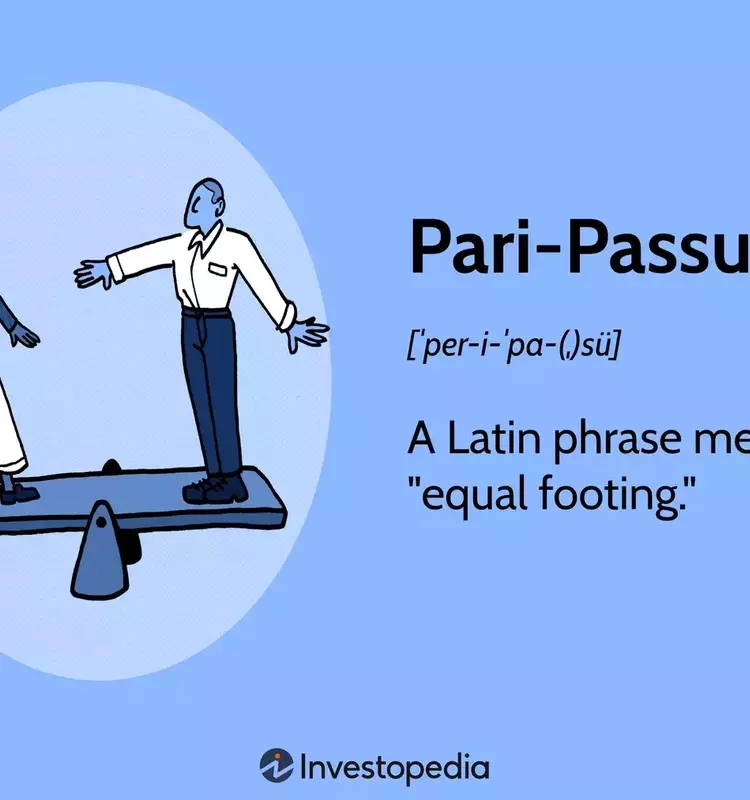
Pari-passu, a Latin term meaning "on equal footing," is a fundamental principle in finance and law that ensures equal treatment for various financial claims, securities, or obligations. It dictates that no party receives preferential treatment over others, particularly crucial in scenarios like bankruptcy proceedings, where all creditors are repaid proportionally. This concept extends to equity shares, bonds, and trusts, ensuring fairness and consistency in financial agreements and distributions.
The Principle of Equal Footing in Finance
The Latin term "Pari-Passu," translating to "on equal footing," signifies a core concept in finance where all involved parties in a financial arrangement or claim are treated without any special preference or priority. This principle is particularly vital in bankruptcy proceedings, where it mandates that all creditors are reimbursed proportionally, ensuring equity in the distribution of remaining assets. It also applies to instruments like equity shares and bonds, where newly issued securities typically carry the same rights as their existing counterparts. Beyond corporate finance, the pari-passu clause is frequently incorporated into wills and trusts, directing that beneficiaries receive equal shares of an estate. This pervasive application of pari-passu underscores its importance in upholding fairness and consistency across diverse financial and legal contexts.
Pari-passu is a guiding principle that ensures equitable treatment in various financial scenarios, primarily dictating that all entities, whether creditors, shareholders, or beneficiaries, are considered equally without any hierarchy of preference. In the context of bankruptcies, this means that any available funds are distributed among creditors in a proportionate manner, preventing any single creditor from gaining an unfair advantage. For equity shares, newly issued shares (e.g., in a secondary offering) are generally pari-passu with existing shares, granting all shareholders equivalent rights concerning dividends, voting, and asset liquidation. Similarly, bonds issued with pari-passu clauses ensure that all bondholders have identical claims to payments and seniority. This concept is not limited to corporate finance; it also extends to estate planning, where wills and trusts often employ pari-passu provisions to guarantee an equal distribution of assets among all named beneficiaries. Thus, pari-passu serves as a cornerstone of fairness, promoting transparency and trust in financial transactions and legal distributions.
Pari-Passu in Unsecured Debts and its Relation to Pro Rata
In finance, the pari-passu principle becomes particularly prominent when dealing with unsecured debts. Unlike secured debts, which are backed by specific assets, unsecured obligations lack collateral, making the equal treatment of creditors crucial during events like default or bankruptcy. The pari-passu clause ensures that all unsecured creditors are reimbursed proportionally from any remaining assets, preventing preferential treatment and fostering equitable loss distribution. This concept often intersects with another Latin term, "pro rata," meaning "in proportion." While pari-passu focuses on the equality of claims, pro rata refers to the proportional distribution based on each party's stake. Counterintuitively, some pari-passu obligations are settled on a pro-rata basis to achieve true equality. For instance, if a debtor with $6,000 in assets owes $10,000 to one creditor and $5,000 to another, a pari-passu arrangement would result in a pro-rata distribution where the first creditor receives $4,000 and the second $2,000, ensuring both incur proportional losses.
The distinction between pari-passu and pro rata is subtle yet significant. Pari-passu fundamentally asserts that all claims or obligations are of equal standing, implying no hierarchy among them. In practice, especially in situations involving insufficient funds, this equality is often upheld through a pro-rata distribution. For example, in the context of parity bonds, all bonds issued under the same pari-passu terms, whether new or existing, possess equivalent rights to coupon payments. This stands in contrast to junior or senior lien bonds, where a clear hierarchy of claims exists, with senior bonds having precedence over junior bonds. Unsecured debts, by their very nature, are subordinate to secured debts and are typically treated pari-passu among themselves to ensure that all unsecured creditors share equally in the available recoveries. This combination of equal standing (pari-passu) and proportional distribution (pro rata) is essential for maintaining fairness and order in complex financial situations, particularly when assets are limited and multiple parties have legitimate claims.
