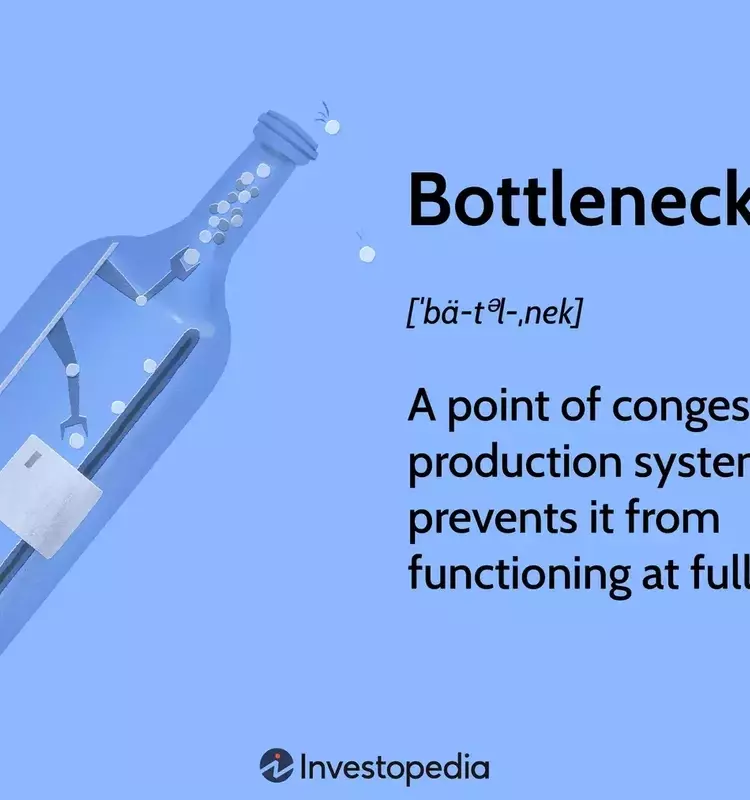
In the complex world of business operations, a "bottleneck" describes a specific stage or process within a system where work accumulates, leading to slowdowns or complete halts. This phenomenon can occur in diverse sectors, from the intricacies of financial systems to the assembly lines of manufacturing and the client-facing interactions of service industries. Analogous to the narrow neck of a bottle restricting liquid flow, these choke points impede the smooth progression of tasks, resulting in increased operational costs, frustrating delays, and overall diminished efficiency.
Bottlenecks manifest in various forms and durations. Temporary constraints, such as an unexpected absence of crucial personnel, can trigger short-term bottlenecks. Conversely, deeply ingrained inefficiencies in production methods or outdated machinery give rise to long-term bottlenecks. For businesses, accurately identifying and addressing these impediments is paramount. Proactive management of production processes involves constant scrutiny to anticipate potential bottlenecks and devise effective strategies for their mitigation. For instance, in manufacturing, a bottleneck can lead to a surplus of raw materials awaiting processing, causing idle machinery and underutilized labor, which directly escalates production expenses and could jeopardize timely delivery to customers.
The repercussions of bottlenecks extend directly to a company's production capacity. While theoretical capacity aims for maximum output, practical capacity acknowledges real-world limitations like equipment maintenance and employee downtime. Exceeding this practical limit often triggers bottlenecks, causing system breakdowns. To overcome these challenges, businesses can either adjust their production targets to align with existing capacity or actively seek solutions to eliminate bottlenecks and boost output. Tools like Capacity Requirements Planning (CRP) are instrumental in setting and achieving production objectives. Moreover, analyzing production variances—the discrepancies between planned and actual outcomes—can pinpoint bottlenecks. For example, higher-than-budgeted labor costs might signal a production holdup, indicating that resolving the bottleneck could lead to significant cost savings and improved resource utilization. The real-world challenges faced by companies like Tesla in ramping up battery production illustrate the critical need for constant innovation and investment to overcome such hurdles and meet escalating demand.
Addressing bottlenecks is not merely about maintaining efficiency; it is about fostering a resilient and dynamic operational environment. By meticulously analyzing processes, investing in human capital and technology, and continuously adapting to evolving demands, businesses can transform potential obstacles into opportunities for growth and innovation. This commitment to continuous improvement ensures that resources are optimized, costs are controlled, and the organization remains agile and competitive in an ever-changing market.
