Understanding Staggered Boards in Corporate Governance
Finance

Understanding Staggered Boards in Corporate Governance

authorBy Suze Orman
DateMay 03, 2026
Read time2 min

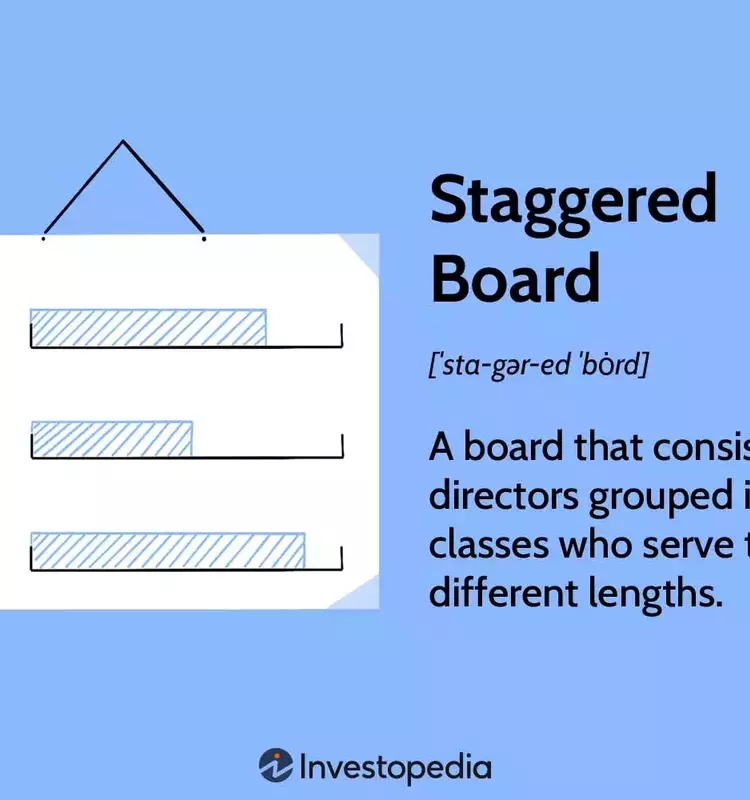
A staggered board, often referred to as a classified board, is a corporate governance mechanism strategically designed to protect companies from hostile takeovers. This structure ensures that only a segment of the board's director positions are up for election in any given year, rather than the entire board. Directors are typically categorized into different classes, each serving terms of varying lengths, thereby creating a staggered election cycle. For instance, a board with nine members might be divided into three classes of three directors each, with each class having different term durations, ensuring that only a third of the board can be replaced annually.

The operational principle behind a staggered board is its ability to significantly prolong the time required for an external party to gain control. By limiting the number of director seats available for election each year, it becomes a substantial hurdle for any entity attempting a hostile takeover, as it would necessitate winning elections over multiple years. This continuity in board composition can also foster long-term strategic planning. However, this structure is not without its detractors. Critics argue that staggered boards can lead to the entrenchment of existing directors, potentially reducing their accountability to shareholders and disincentivizing them from prioritizing shareholder value, especially in the absence of external pressure from activist investors or unsolicited bidders.

Despite the protective advantages against rapid corporate control shifts, the prevalence of staggered boards has been decreasing. A 2016 Harvard study indicated a significant decline in their adoption among S&P 1500 and S&P 500 companies, largely influenced by shareholder advocacy initiatives like the Shareholder Rights Project. Empirical evidence further supports this trend, with studies suggesting that companies employing staggered boards tend to yield lower shareholder returns compared to those with annually elected boards. This reinforces the argument that, while offering stability, staggered boards might not always align with the best interests of shareholders.

In the dynamic world of corporate governance, finding a balance between stability and accountability is crucial. While staggered boards historically offered a defense against opportunistic takeovers, the evolving landscape of corporate ownership and shareholder activism has shifted the focus towards structures that prioritize transparent governance and direct accountability. Companies are increasingly recognizing that long-term success is not solely about fending off external threats, but also about fostering an environment where leadership is responsive, agile, and genuinely committed to maximizing value for all stakeholders through robust and equitable governance practices.

More Articles
Finance
Understanding Black Monday: Causes, Aftermath, and Lessons Learned
Black Monday refers to the stock market crash on October 19, 1987, when the Dow Jones Industrial Average (DJIA) plummeted 22.6% in a single day, triggering a global financial crisis. This article explores the causes of this historic downturn, including program trading and portfolio insurance, and examines the regulatory responses, such as the introduction of circuit breakers, designed to prevent future market panics. It also delves into lessons learned from Black Monday and other significant market crashes, emphasizing the importance of long-term investment strategies and viewing downturns as potential buying opportunities.
By Robert KiyosakiMay 03, 2026
Finance
US Manufacturing Surges in April: PMI Reaches Near Four-Year High
U.S. manufacturing experienced significant growth in April, with the S&P Global PMI hitting 54.5, its highest level in nearly four years. This expansion was primarily fueled by companies building up inventories in anticipation of supply chain disruptions and price increases due to geopolitical tensions. The index has now been in expansion territory for nine consecutive months, exceeding forecasts.
By Michele FerreroMay 03, 2026
Finance
Understanding Product Warranties: Consumer Protection and Types
Warranties are legally binding assurances from manufacturers or sellers regarding a product's quality and performance. They offer consumers recourse for repairs, refunds, or exchanges if a product fails to meet specified conditions. This article explores how warranties function, the differences between explicit and implicit guarantees, and the legal frameworks protecting buyers, such as the Magnuson-Moss Warranty Act.
By Fareed ZakariaMay 03, 2026
Finance
India's Industrial Sickness Act: Evolution and Repeal
The Sick Industrial Companies Act (SICA) was an Indian law enacted in 1985 to identify and rehabilitate or liquidate financially distressed industrial units. It aimed to free up capital locked in unviable enterprises for more productive use. Replaced in 2003 and fully repealed in 2016, its functions were absorbed by new legal frameworks like the Companies Act of 2013 and the Insolvency and Bankruptcy Code of 2016, transferring oversight to bodies like the National Company Law Tribunal (NCLT).
By Michele FerreroMay 03, 2026
Finance
Allspring Multi-Sector Income Fund: A Detailed Analysis of Performance and Outlook
The Allspring Multi-Sector Income Fund (ERC) offers a 9.4% yield with a 6.9% discount to its Net Asset Value (NAV). While recent earnings cover distributions, the fund's reliance on realized gains introduces volatility, particularly during market downturns. Its globally diversified portfolio, heavily invested in below-investment-grade debt, makes it sensitive to interest rate fluctuations. Although NAV trends are currently positive, the fund lacks significant capital appreciation potential, making it suitable mainly for income-focused investors.
By Michele FerreroMay 03, 2026