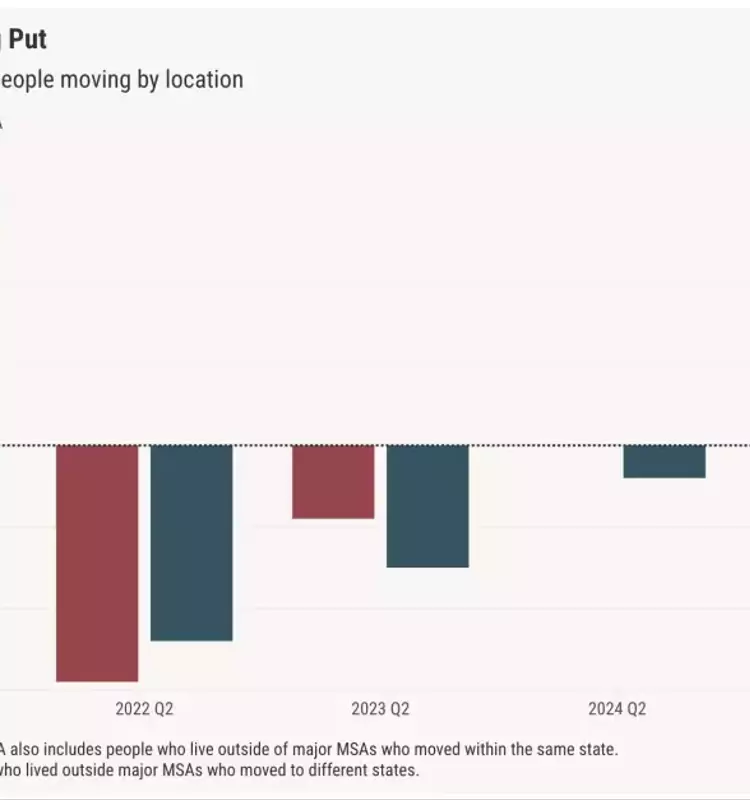
The United States is currently experiencing a notable deceleration in its population's mobility, a trend significantly influenced by prevailing economic conditions. A comprehensive report from the Bank of America Institute indicates that the overall rate of Americans relocating in 2025 has sharply decreased, hovering considerably beneath the figures observed before the global pandemic. This downturn is largely driven by a softening labor market and the pervasive 'lock-in effect' within the housing sector, compelling many to remain in their current residences. While certain urban centers in the South and Midwest continue to attract new inhabitants, the broader picture reflects a populace less inclined to move, underscoring the profound impact of interest rates and housing affordability on individual decisions.
Detailed Insights into Shifting Relocation Dynamics Across America
In a revealing analysis published by the Bank of America Institute, a pronounced reduction in the mobility of American residents has become evident in 2025. Data from the first quarter of 2025 shows an almost 20% decrease in total relocations when juxtaposed with the corresponding period in 2020, signaling a sustained divergence from pre-pandemic migratory trends. Despite fleeting indications of a resurgence earlier in the year, this momentum failed to persist into the second quarter. The Institute's findings, derived from anonymized internal account information, underscore a notable year-over-year decline in both interstate and intracity residential changes, with an especially sharp drop in moves within the same metropolitan areas.
Geographically, while the overall trend points to decreased movement, certain metropolitan areas defy this pattern. Cities such as Indianapolis and Columbus, Ohio, have emerged as frontrunners in attracting new residents, alongside consistent inflows into Austin and San Antonio, Texas. Conversely, a majority of urban centers in the Western and Northeastern regions have experienced net outflows. Even Florida, historically a magnet for internal migration, has witnessed a cooling effect, with Miami, Orlando, and Tampa registering net departures. The Institute observed that the intensity of both inbound and outbound migration appears to have softened relative to the first quarter, suggesting a more settled population.
From a demographic standpoint, although younger generations—specifically Gen Z and Millennials—still account for a substantial portion of cross-city moves, their share has gradually diminished over the past year. In contrast, Baby Boomers and older age groups now constitute a marginally larger percentage of those relocating. This generational shift is largely attributable to the current state of the job market. The Bank of America's 2024 Homebuyer Insight Report highlighted that over 40% of survey participants indicated a willingness to move across state lines for employment opportunities, illustrating the critical role of job prospects in driving long-distance residential changes.
Another significant impediment to mobility is the constrained housing supply. Despite recent improvements in new home construction, the inventory of existing homes remains critically low. A primary driver of this scarcity is the 'lock-in effect,' where homeowners are disinclined to sell properties financed with historically low mortgage rates, as selling would necessitate acquiring a new mortgage at significantly higher current rates. This phenomenon is particularly acute in Western states, where a considerable proportion of households benefit from mortgage rates below 5% and allocate over 30% of their income to housing expenses, creating a formidable barrier to market activity. Similar challenges are observed in major urban centers such as New York, Washington, D.C., Miami, and Austin, where the combination of high mortgage burdens and reluctance to list properties continues to stifle the housing market.
Looking ahead, the Bank of America Institute cautions against anticipating a swift recovery in mobility, despite the encouraging signs from new construction. The Institute predicts that the 'lock-in effect' will only gradually dissipate over time, primarily through 'forced moves'—relocations triggered by unavoidable life events like job changes, divorces, or deaths. While new builds are progressively enhancing housing availability, the Institute emphasizes that the constraint posed by the 'lock-in effect,' particularly in regions like the West, is likely to endure for the foreseeable future, underscoring the complexities of the current housing landscape.
This detailed report by the Bank of America Institute provides a profound reflection on the current state of American residential mobility, presenting a compelling narrative of how economic pressures, particularly in the housing and job markets, are shaping individual decisions to stay put. As a keen observer of societal trends, one can't help but feel a sense of unease about the implications of such widespread immobility. The 'lock-in effect' isn't merely an economic term; it represents countless personal stories of individuals feeling tethered to their current homes, potentially sacrificing opportunities for career advancement or a better quality of life in a different location. It raises questions about the long-term vitality of communities that are experiencing net outflows and the increasing burden on those still drawing new residents. This situation calls for innovative policy solutions and a deeper understanding of human behavior in the face of economic constraints. Perhaps, it also prompts a re-evaluation of what constitutes 'home' in a rapidly evolving economic landscape.