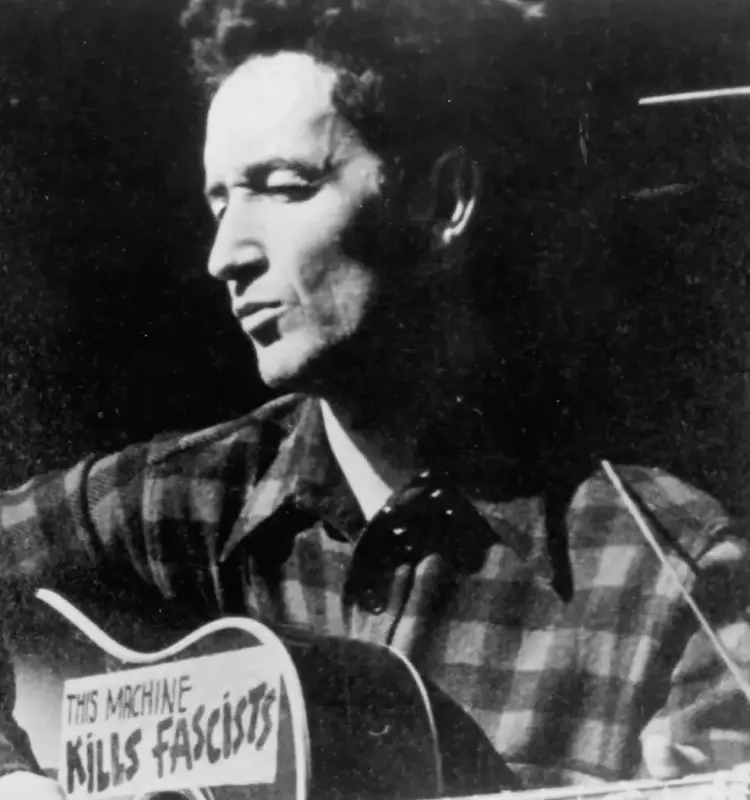
A long-lost recording of Woody Guthrie's powerful song, 'Deportee (Woody's Home Tape),' shedding light on the tragic plight of deported migrant workers, has recently resurfaced. This raw, talk-sung rendition, featuring Guthrie's original lyrics over simple guitar accompaniment, will be a central piece in the upcoming album 'Woody at Home — Volumes 1 + 2,' slated for release on August 14th by Shamus Records. The discovery offers an intimate glimpse into the folk icon's creative process and his unwavering commitment to social commentary, reinforcing the timeless relevance of his work in addressing issues of human dignity and social injustice.
A Timeless Ballad Echoes Through Decades: The Story Behind 'Deportee'
In the sobering aftermath of a tragic incident in June 1948, near Coalinga, California, an aircraft transporting deported Mexican laborers crashed, claiming the lives of all 32 individuals on board. Among the deceased were 28 migrant workers, yet initial press reports, notably in the New York Times, focused primarily on identifying the four American crew members, referring to the others simply as \"Mexican deportees.\" This glaring omission of identity profoundly moved folk legend Woody Guthrie, then residing on Long Island, who penned the stirring lyrics to \"Deportee\" the following month.
Guthrie’s granddaughter, Anna Canoni, president of Woody Guthrie Publications, highlighted the song as a profound observation of the disparity in how the United States regarded foreign laborers. She emphasized that Guthrie's intention was not merely anger or frustration, but a deep humanistic critique of the prevailing dehumanization.
While later versions of the song, famously set to music by Colorado folksinger Martin Hoffman and covered by musical giants such as Pete Seeger, Bruce Springsteen, and Joan Baez, adopted a third-person narrative, this newly unearthed recording from Guthrie’s home in Brooklyn reveals a more personal, first-person perspective. The lyrics, \"I don't have a name and I ride this big airplane/And just call me one more deportee,\" emphasize the individual tragedy and anonymity of the workers, making this version exceptionally poignant. This rare recording was made during a period when Guthrie was contending with the initial manifestations of Huntington's disease, the illness that would eventually lead to his hospitalization, where a young Bob Dylan would later visit him—a scene famously depicted in the recent Dylan biopic, 'A Complete Unknown.'
This significant collection, 'Woody at Home — Volumes 1 + 2,' also features nearly two dozen other previously unheard recordings, including an extended rendition of \"This Land Is Your Land\" with additional verses, alongside home recordings of \"Pastures of Plenty\" and \"Jesus Christ.\" Yet, it is \"Deportee\" that resonates most deeply, serving as a powerful reminder of ongoing struggles for migrant rights and human dignity. As Canoni aptly put it, her grandfather believed a song was \"a conversation you can have again and again,\" suggesting that the vital dialogue around these issues must continually be revisited.
From a journalist's perspective, the discovery of Woody Guthrie's original recording of 'Deportee' transcends mere musical archaeology; it serves as a powerful testament to the enduring role of art in social justice. In an era where discussions around immigration and labor rights continue to dominate headlines, Guthrie's raw and deeply personal interpretation of the migrant experience remains strikingly relevant. It reminds us that behind every statistic and policy debate are individual human stories, often overlooked and unheard. This unearthed piece not only enriches our understanding of Guthrie’s profound empathy and prophetic vision but also challenges contemporary society to confront its own narratives about those who labor in the shadows. The song's persistent message, echoing through decades, underscores the critical need for compassion and recognition for all individuals, regardless of their origin or status.