Amazon recently achieved a significant milestone, briefly surpassing a $3 trillion market capitalization in early August. This achievement has sparked discussions among financial analysts regarding the company's future growth potential and stock performance. Despite a subsequent slight decline from this peak, a consensus among experts suggests substantial upward movement for Amazon's stock in the coming months, primarily propelled by the robust expansion of its cloud computing division, Amazon Web Services (AWS), and strategic investments in artificial intelligence. The optimistic outlook is underpinned by strong quarterly revenue figures and a comparison with key industry rivals, positioning Amazon for continued success and a favorable return for investors.
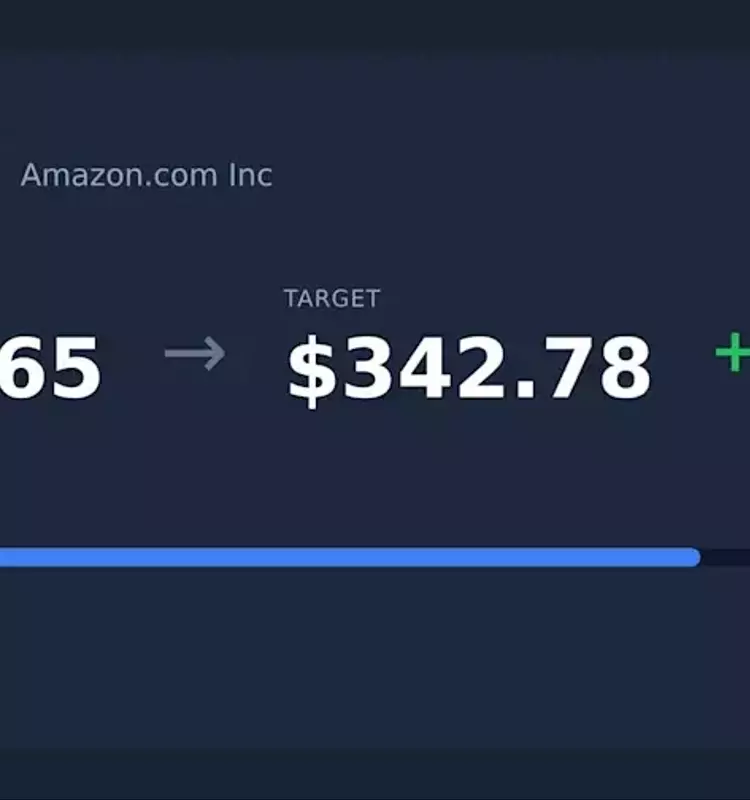
On August 17, 2026, Amazon's stock was trading at $262.65, having briefly exceeded the $3 trillion valuation earlier in the month. This momentary surge was followed by a 4.31% retreat, placing the stock 14% below its 52-week high of $287.20. Adding to the short-term market dynamics, news of founder Jeff Bezos selling approximately $4 billion in shares coincided with the milestone, contributing to the pressure on the stock price. Nevertheless, the prevailing expert opinion, including that of 24/7 Wall St., projects a buy rating with a 12-month price target of $342.78, indicating a potential upside of 30.51% and a 90% confidence level in this forecast.
The company's financial fundamentals show considerable acceleration. In the second quarter of fiscal year 2026, Amazon reported revenues of $200.61 billion, marking a 19.62% year-over-year increase. A critical driver of this growth is AWS, which expanded by 36.7%, its fastest pace in 18 quarters, boasting an annualized run rate of $169 billion and a $496 billion backlog. CEO Andy Jassy has expressed ambitious long-term projections for AWS, envisioning it as a potential "trillion dollar annual revenue business." Furthermore, Amazon's investments in AI and custom chips have yielded over $25 billion in annualized run rates, demonstrating triple-digit growth, with Jassy noting that a significant portion of capacity for 2027 is already reserved, particularly for major commitments from companies like Anthropic and OpenAI. The company's advertising segment also saw strong performance, growing 26% to reach $19.81 billion.
When comparing Amazon to its cloud competitors, Microsoft's Azure exhibited 43% growth in the last quarter, slightly outperforming AWS in terms of growth rate, and holds a larger backlog of $678 billion. Microsoft's stock trades at a P/E ratio of 28 with an impressive operating margin of 46.8%, considerably higher than Amazon's 11.16%. Despite Microsoft's premium valuation, Amazon's stock is considered reasonably priced given its growth prospects. Alphabet, with its Google Cloud, reported an even more rapid expansion of 82% in Q2, reaching $24.77 billion, underscoring the fierce competition in the hyperscaler market. Alphabet's market capitalization of $4.23 trillion, surpassing Amazon's despite a smaller retail footprint, suggests investors are willing to pay a premium for accelerating cloud AI capabilities, which further supports the optimistic valuation for Amazon.
The bullish case for Amazon projects its stock price could reach $394.04, representing a 50% return over one year. This scenario hinges on the continued strong performance of AWS, particularly its ability to maintain over 30% growth into the third quarter. Risks to this optimistic outlook include significant capital expenditures, which totaled $54.21 billion in Q2 and are guided at roughly $200 billion for the full year 2026. This heavy investment could pressure free cash flow, which currently stands at a negative $7.6 billion on a trailing twelve-month basis. However, Jassy views these expenditures as a timing mismatch, where data centers are built years in advance of revenue generation. Additional challenges include tariff exposure, foreign exchange headwinds, and intense competition from other major cloud providers. The current market setup, considering these factors, indicates a favorable risk-reward balance for existing and potential shareholders.
