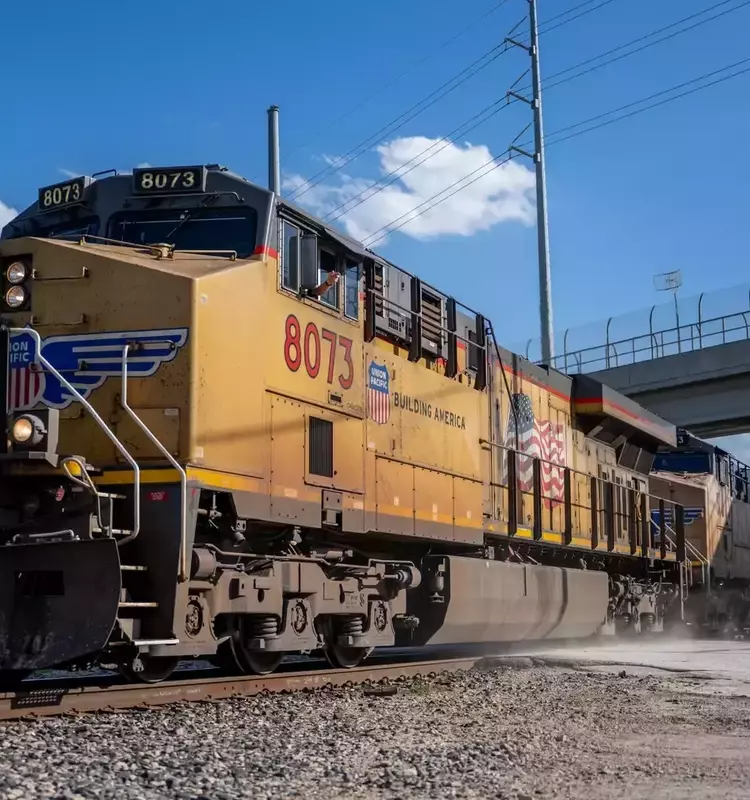
Despite its historical roots in the Gilded Age, the freight rail industry continues to be a crucial component of North America's economic framework. Railroad companies are essential to the transportation sector, making their stocks worthy of investor scrutiny. Given their cyclical nature, opportunities to trade these stocks frequently arise. Today, a significant volume of cargo not moved by trucks relies on rail transport, with a limited number of companies managing this vital infrastructure.
The Indispensable Role of Freight Rail in Today's Economy
Freight rail companies operate by charging for the transportation of cargo across their extensive networks of tracks and railcars. While the Surface Transportation Board regulates rates and other operational aspects, the practicalities are more intricate. In North America, major freight railroads largely function as duopolies, with distinct channels dominating different regions. Union Pacific (UNP) and Berkshire Hathaway’s (BRK.A) Burlington Northern Santa Fe (BNSF) manage routes across the Western U.S., while Norfolk Southern (NSC) and CSX (CSX) control the East. In Canada, CPKC (CP) and Canadian National (CNI) operate, with CPKC also holding routes in the Central U.S. and Mexico.
The rail industry categorizes railroads by size and revenue into Class I, II, and III, though these distinctions are often of questionable practical value. Beyond the large continental networks, smaller short-line railroads offer profitable opportunities by connecting industries to supply sources or linking smaller communities to major rail lines.
Intermodal operations are increasingly central to modern rail transport. This system utilizes standardized containers that can be seamlessly transferred between ships, trains, and trucks without needing to unload and reload the cargo. This efficiency, facilitated by direct rail access to ports, significantly reduces costs and accelerates delivery times, making rail an even more competitive option.
Currently, 43% of all intercity freight in the U.S. is transported by rail, including over two-thirds of the nation’s coal and substantial volumes of chemicals, grains, and automobiles. Rail transport also boasts superior safety records and fuel efficiency, moving a ton of freight over 430 miles on a single gallon of fuel. Despite differing emissions standards and the sheer volume of trucks, railroads remain a pivotal and enduring mode of transportation.
Rail traffic serves as a reliable economic indicator. Carload traffic and the deployment of railcars correlate directly with economic activity. Intermodal traffic provides insights into international trade, and the composition of freight offers clues about the strengths and weaknesses of various economic sectors, such as the housing market’s impact on lumber shipments.
Navigating the Tracks: Insights for Rail Investors
Investing in rail companies requires a keen eye for specific industry metrics alongside traditional financial analysis. While investors should still seek revenue growth, robust profit margins, and efficient capital deployment, the rail sector demands a unique evaluation approach. The operating ratio, calculated as operating expenses as a percentage of revenue, is a critical profitability measure, with an ideal target in the mid-70s.
Analyzing top-line growth involves looking at both volume and pricing strategies. Long-term contracts, while offering stability during economic downturns, can limit profitability during recovery periods. Furthermore, the substantial capital expenditures required for maintaining vast rail networks, freight infrastructure, and locomotives often result in lower free cash flow conversion compared to other industries. However, the duopolistic nature of the rail market often translates into a more secure and lower-risk return on infrastructure investments.
Investors must also be aware of several inherent risks. Fuel costs, which can account for up to 20% of operating expenses, pose a challenge, as companies cannot always fully hedge against price increases. Labor costs, heavily influenced by unionization, represent over a third of operating expenses for some operators. The high capital requirements necessitate access to cost-effective capital. Additionally, as service providers, railroads are inherently cyclical, their performance tied directly to overall economic activity, making them less suitable for long-term buy-and-hold strategies. Valuing rail companies can also be complex due to high capital expenditure needs, often requiring the use of adjusted discounted cash flow models or alternative metrics like price-to-book, EV/EBITDA, and price-to-earnings ratios.
In conclusion, while the rail industry presents unique challenges and requires a specialized investment perspective, its fundamental role in economic infrastructure and its duopolistic market structure offer compelling opportunities for well-timed investments. The continuous movement of goods is the lifeblood of commerce, and railroads remain at the forefront of this essential function in North America.
