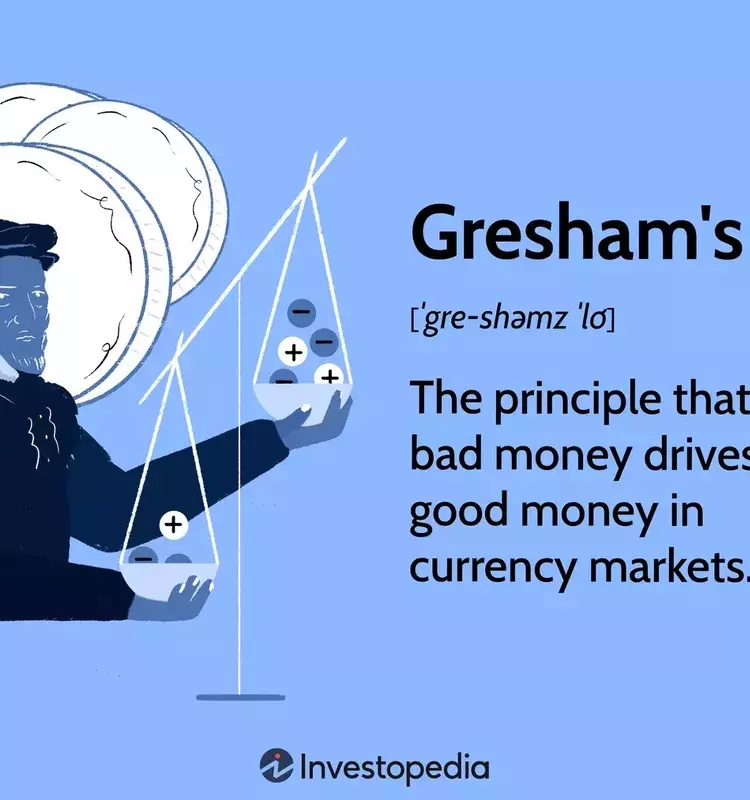
Gresham's Law: Understanding Currency Dynamics
Finance

Gresham's Law: Understanding Currency Dynamics

authorBy David Rubenstein
DateApr 29, 2026
Read time2 min

Gresham's Law elucidates a fundamental principle in economics: when multiple forms of currency are legally assigned the same value, but one possesses a higher intrinsic worth, the less valuable form will actively circulate, while the more valuable one will be withheld from circulation. This concept, often distilled into the maxim 'bad money drives out good,' traces its origins to historical practices of coining precious metals. Over time, as currencies transitioned from pure metal compositions to alloys and eventually paper, this law continued to explain observable phenomena in currency markets, influencing stability and usage patterns globally.

Historically, the debasement of coinage played a significant role in demonstrating Gresham's Law. Rulers would reduce the precious metal content of coins while maintaining their face value, leading people to hoard the older, more valuable coins and spend the newer, less valuable ones. This dynamic, observed by Sir Thomas Gresham in the 16th century and later formalized, extended beyond metallic currency to modern fiat systems. During hyperinflationary periods, like Zimbabwe's in 2008, the local, rapidly depreciating currency was shunned in favor of more stable foreign currencies, illustrating how perceived intrinsic value, even in paper money, influences circulation. Such events highlight the critical role of legal tender laws in either enforcing or challenging the natural operation of Gresham's Law.

Understanding Gresham's Law offers valuable insights into currency-related issues and informs economic policy decisions. While its direct manifestations might be less frequent in today's predominantly fiat currency systems, the underlying principles continue to be relevant in scenarios of currency debasement or economic instability. The law serves as a reminder that the perceived value of money, whether intrinsic or enforced by law, profoundly impacts its circulation and the broader economic landscape, guiding individuals' decisions to either spend or save different forms of currency.

By recognizing the forces described by Gresham's Law, individuals and policymakers can better navigate the complexities of currency markets and economic fluctuations. It encourages a proactive approach to maintaining currency stability and fostering trust in monetary systems, ensuring that economies function smoothly and equitably. The principle underscores the importance of sound monetary policies that uphold the value and integrity of a nation's currency, ultimately contributing to a robust and dependable economic environment for all.

More Articles
Finance
Global Stock Fund's Q1 Performance and Macroeconomic Headwinds
The BNY Mellon Global Stock Fund experienced underperformance against the MSCI World Index in the first quarter of 2026. This period was marked by increased volatility in asset markets and rising energy prices, primarily due to the ongoing conflict in the Middle East. The fund's future economic growth and corporate earnings are highly dependent on the duration and scope of this geopolitical instability.
By Robert KiyosakiApr 29, 2026
Finance
The Enduring Value of a College Degree Amidst Changing Economic Landscapes
Despite rising tuition costs and the increasing influence of AI on the job market, a college degree continues to offer significant long-term benefits. College graduates typically experience higher earning potential, greater salary growth over their careers, and lower unemployment rates compared to those without a degree. However, the financial burden of student loans and the specific field of study can impact the overall return on investment, emphasizing the need for strategic educational choices.
By Mariana MazzucatoApr 29, 2026
Finance
Maximizing Tax Benefits for Self-Employed Parents
Self-employed parents can leverage various tax deductions and credits to reduce their tax liability. This guide explores key areas such as child and dependent tax benefits, medical expenses, and education-related deductions, offering strategies to optimize financial outcomes.
By Nouriel RoubiniApr 29, 2026
Finance
Unveiling Consumer Desires: The Theory of Revealed Preference
The theory of revealed preference, a cornerstone of economic thought, posits that consumer choices, when observed under consistent income and price conditions, are the most reliable indicators of their true preferences. Developed by Paul Samuelson in 1938, this theory offers an observable alternative to the elusive concept of utility, assuming rational decision-making and adhering to fundamental axioms like WARP, SARP, and GARP to analyze how individuals make purchasing decisions within their budget constraints.
By Lisa JingApr 29, 2026
Finance
Understanding Escrow: A Comprehensive Guide to Secure Transactions
This article explores the concept of escrow, a financial mechanism where a neutral third party holds funds or assets until specific conditions in a transaction are met. It delves into how escrow operates across various sectors like real estate, stock markets, and online sales, highlighting its role in safeguarding both buyers and sellers. The discussion also covers different types of escrow accounts, their advantages and disadvantages, and provides practical examples to illustrate their application in securing financial dealings.
By Fareed ZakariaApr 29, 2026