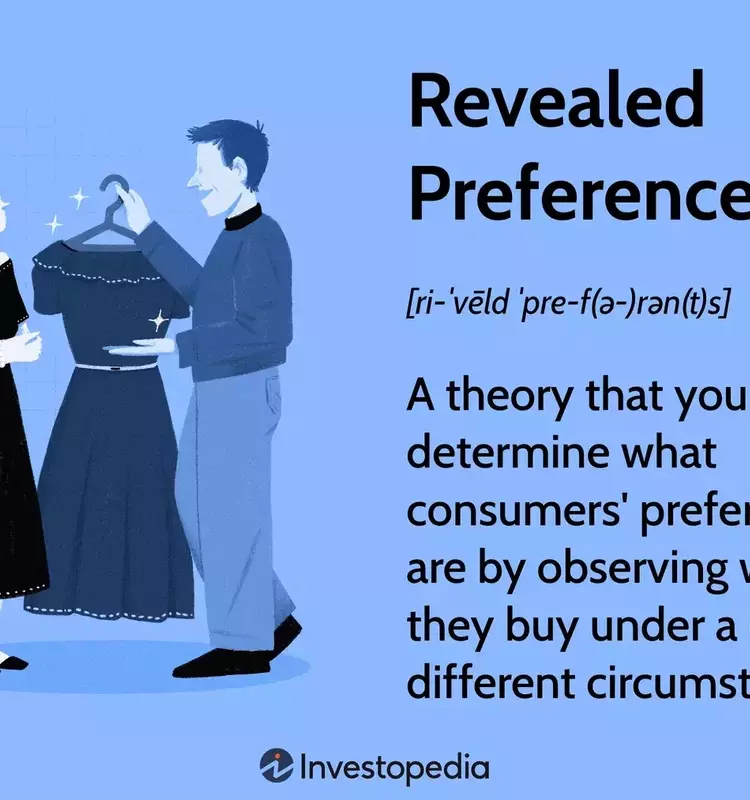
In the expansive realm of economic analysis, the theory of revealed preference stands as a pivotal framework, asserting that an individual's actual purchasing decisions serve as the most telling evidence of their underlying preferences. This theory, initially proposed by the distinguished American economist Paul Anthony Samuelson in 1938, emerged as a pragmatic alternative to the often-intangible concept of utility, which had traditionally been employed to understand consumer satisfaction. By focusing on observable behavior rather than subjective internal states, revealed preference theory offers a more empirical lens through which to examine how consumers prioritize and select goods and services within the constraints of their budgets and market prices.
The Core Insights of Revealed Preference Theory
For a considerable period, the study of consumer choices, particularly what drives individuals to opt for one product over another, was predominantly anchored in the notion of utility. Utility, in economic parlance, quantifies the satisfaction or pleasure derived from consuming a product or service. However, the inherent difficulty in precisely measuring this subjective concept led to calls for more concrete theoretical foundations. Samuelson's "Revealed Preference Theory" revolutionized this perspective by suggesting that consumer behavior is not necessarily dictated by an unquantifiable utility, but rather by demonstrable actions based on a set of logical and generally accepted assumptions.
This theory operates on the fundamental premise that consumers are rational actors. This implies that before making any purchase, an individual consciously evaluates a range of available alternatives and ultimately chooses the option that they deem most beneficial or desirable. Consequently, if a consumer selects a particular item from a given set of choices, that item is, by definition, their preferred option among those available. The theory further acknowledges that these preferences can dynamically shift in response to changes in pricing and budgetary limits. By meticulously studying these shifts in purchasing patterns under varying financial conditions, economists can construct a comprehensive understanding of what consumers collectively favor across different budget and price scenarios.
A key tenet of revealed preference theory states that, given a fixed budget, a consumer will consistently choose the same 'bundle' of goods as long as that bundle remains within their financial reach. A deviation from this consistent choice, leading to the selection of a less preferred bundle, is expected only if the initially chosen, more desirable option becomes financially inaccessible. Samuelson's original intent with this theory was to build upon Jeremy Bentham's concept of diminishing marginal utility, finding a quantifiable method to assess the enjoyment derived from goods, which Bentham had deemed challenging to measure directly. Over time, economists have significantly expanded upon this foundational theory, and it continues to be a crucial tool for analyzing real-world consumer data and understanding the intricate mechanics of consumption patterns.
Central to the application and understanding of revealed preference theory are its three foundational axioms: the Weak Axiom of Revealed Preference (WARP), the Strong Axiom of Revealed Preference (SARP), and the Generalized Axiom of Revealed Preference (GARP). The Weak Axiom (WARP) stipulates that if a consumer chooses product A over product B under a specific set of prices and income, they will never choose product B over product A if product A is still affordable. This implies consistency in consumer choices, where a preferred item is always chosen unless an alternative offers superior benefits, such as a lower price, greater convenience, or enhanced quality. The Strong Axiom (SARP) extends this logic, particularly relevant in scenarios with only two goods, where it effectively equates to the weak axiom. The Generalized Axiom (GARP) addresses situations where multiple consumption bundles might offer the same level of benefit or 'utility' at a given income and price point, acknowledging that a unique, utility-maximizing bundle isn't always present. For instance, consider a consumer who buys a pound of grapes. Revealed preference theory suggests this consumer prefers grapes over all other items of equal or lesser cost. They would only switch to a less preferred substitute if grapes became too expensive. However, critics of the theory question the assumption that consumer preferences remain constant over time, arguing that a choice made at one moment might only reflect a temporary preference. In a world brimming with countless alternatives, precisely determining which products or options were foregone in favor of a chosen item like an apple remains a complex and often unanswerable question.
The theory of revealed preference, while providing a powerful framework for understanding consumer behavior through observable actions, faces limitations regarding its underlying assumptions. The biggest challenge lies in substantiating the constancy of consumer preferences over time, an assumption that doesn't always hold true in the dynamic marketplace. Furthermore, in an environment saturated with choices, isolating the exact set of alternatives a consumer considered and rejected before a purchase can be incredibly difficult, complicating the application of the theory to real-world scenarios. Despite these criticisms, its emphasis on empirical observation remains a valuable contribution to economic analysis.
