Housing Market Confidence Declines as Concerns Over Job Stability and Home Prices Rise
Loan

Housing Market Confidence Declines as Concerns Over Job Stability and Home Prices Rise

DateSep 09, 2025
Read time3 min
The latest report from Fannie Mae reveals a nuanced picture of the housing market, where shifting consumer sentiments paint a complex landscape of optimism and apprehension regarding homeownership and related economic factors.

Navigating Uncertainties: A Closer Look at Shifting Housing Sentiments

August Market Overview: A Slight Dip in Housing Confidence

In August, American consumers displayed a marginal decrease in their confidence levels concerning the housing sector. This shift was largely influenced by increasing anxieties regarding job market stability, the ease of selling properties, and the prospective direction of residential property values. These findings stem from Fannie Mae's comprehensive monthly National Housing Survey, which tracks various aspects of consumer attitudes towards housing.

Key Indicators and Their Performance in August

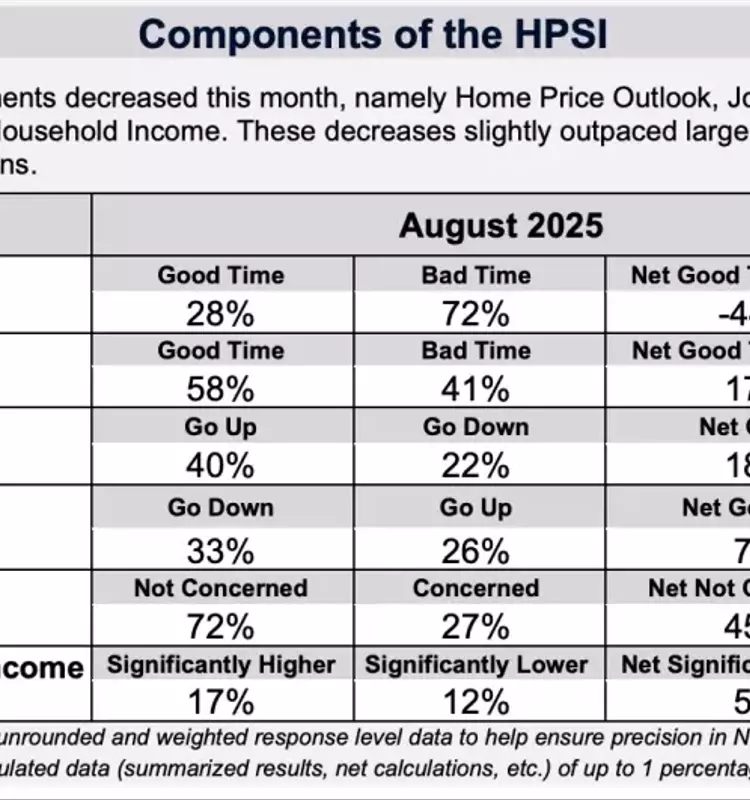
The Home Purchase Sentiment Index (HPSI), a crucial measure of consumer sentiment, registered a modest decline of 0.4 points, settling at 71.4. A majority of its six constituent components showed a downturn. While there was a more favorable perception of mortgage rates and the conditions for purchasing a home, these encouraging signs were insufficient to counteract the negative trends observed in seller confidence, anticipated housing appreciation, household income expansion, and employment security.

Buyer vs. Seller Sentiment: A Diverging Path

Despite the overarching drop in sentiment, a notable proportion of consumers viewed August as a more opportune moment for acquiring a residence. Approximately 28% of respondents considered it a good time to buy, marking a five-percentage-point increase from the previous month. Conversely, the percentage of those who deemed it a poor time to buy decreased to 72%. This collective shift resulted in a nine-point improvement in net buyer sentiment. However, seller optimism moved in the opposite direction, with 58% believing it was a good time to sell and 41% viewing it negatively. Furthermore, expectations for property appreciation softened, with only 40% anticipating a rise in home values over the coming year.

Mortgage Rates and Job Security: Mixed Signals

A notable positive development was the sentiment surrounding mortgage rates. For the first time since January, more respondents anticipated a decline in rates over the next 12 months than an increase. In contrast, confidence in job security and household income saw a decline. The proportion of employed individuals who felt secure in their jobs fell by five points to 45%, and only 17% reported an increase in their income compared to the previous year, with the majority (70%) stating their earnings remained unchanged.

Rental and Home Price Expectations: A Comparative Analysis and Other Survey Highlights

Expectations for rental price increases moderated, with consumers forecasting an average rise of 4.9% over the next year, a decrease from July's projections. Conversely, home prices were expected to climb by an average of 1.4%, an uptick from July's estimates. Additional insights from Fannie Mae's August survey indicated that 68% of respondents would prefer to buy rather than rent if they were to relocate, a two-point increase. About 55% described securing a mortgage as challenging, a slight increase from July. Approximately one-third expected their personal finances to improve, while 22% foresaw a decline, figures that remained consistent. Views on the broader economic landscape showed a slight improvement, with 35% believing the U.S. economy was on the right trajectory, a three-point increase.

More Articles
Enhancing Real Estate Agent Retention Strategies
This article explores key strategies for real estate brokerages and team leaders to improve agent retention. It delves into various aspects crucial for agent satisfaction and longevity, including comprehensive training programs, advanced technological tools, mentorship opportunities, supportive company culture, and robust lead generation systems. The piece emphasizes the importance of a holistic approach to foster an environment where real estate professionals feel valued, supported, and equipped for success in a competitive market.
Sep 09, 2025
Property Market Downturn: Higher Stamp Duty and Budget Rumors Impact Lending
Mortgage lending in the UK saw a significant 24.2% drop between April and June following increased stamp duty costs. Rumors of further property tax changes in the upcoming Autumn Budget are causing additional market uncertainty, with experts predicting a continued slowdown until clarification is provided. First-time buyers face substantially higher costs, particularly in London, exacerbating market challenges.
Sep 09, 2025
U.S. Housing Market Reaches Record Value Amid Shifting Dynamics
The total value of U.S. homes has reached a new high of $55.1 trillion, an increase of $20 trillion since early 2020. However, growth has slowed in the past year due to high housing costs. While the national market experienced a modest gain, some major states saw declines in housing values, notably Florida, California, and Texas, while New York recorded significant growth. New construction has played a crucial role in wealth creation and addressing affordability issues, especially in states with substantial population influx during the pandemic. Nine major U.S. metropolitan areas now boast housing markets valued at over $1 trillion each.
Sep 08, 2025
London Property Preferences: The 'Pear' Outshines the 'Banana'
A recent analysis by Rightmove reveals that London's most sought-after areas for homebuyers do not align with the widely discussed 'London banana' theory. Instead, a 'London pear' formation emerges, encompassing more affordable neighborhoods that attract a greater number of prospective buyers, indicating a shift in housing priorities towards value and accessibility.
Sep 08, 2025
Soaring Insurance Costs Escalate Homeownership Burdens
Homeowners are increasingly burdened by property insurance costs, which now outpace principal, interest, and taxes, according to the latest ICE Mortgage Monitor. Averaging nearly $2,370 annually, these costs represent 9.6% of monthly mortgage-related expenses, a record high. The report highlights significant regional variations, with California seeing sharp increases, while Florida shows signs of moderation. These rising expenses underscore growing affordability challenges and the critical need for enhanced data and integrated technological solutions in the housing market.
Sep 08, 2025