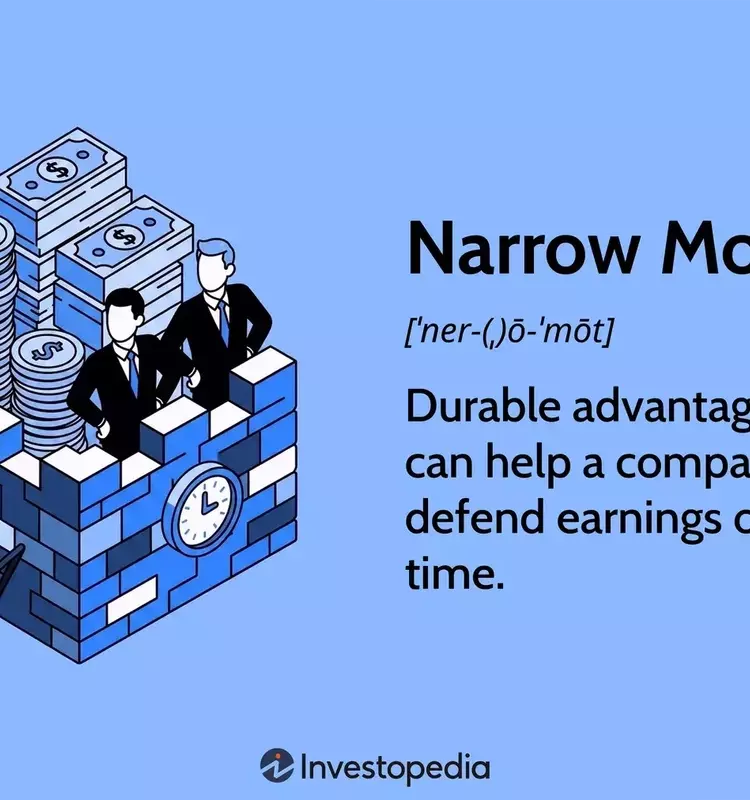
In the realm of business and finance, the term "narrow economic moat" refers to a company's ability to maintain a slight competitive edge over its industry peers. This concept, initially introduced by renowned investor Warren Buffett, distinguishes between companies with substantial, long-lasting advantages (wide moats) and those with more modest, short-term benefits. A narrow moat indicates that while a company has some advantages, these are often quickly eroded by market competition, limiting their long-term economic impact.
The notion of an "economic moat" metaphorically represents a company's protective barrier against competitors, akin to a castle's moat. A narrow moat suggests a less formidable defense, meaning the company's advantages are not strong enough to deter new entrants or aggressive rivals effectively. This often occurs in industries characterized by high competition, low barriers to entry, and limited opportunities to safeguard intellectual property. Consequently, businesses operating with narrow moats must constantly innovate and adapt to sustain their profitability.
Companies with narrow economic moats typically find it challenging to achieve market dominance, even if they experience periods of success. Their competitive advantages, such as minor cost efficiencies or a slightly recognized brand, can be easily replicated or overcome by competitors. For example, in industries where products are largely undifferentiated, a small price advantage might attract customers temporarily, but this can be quickly matched by rivals. This contrasts sharply with companies enjoying wide moats, whose deep-seated advantages—like proprietary technology or strong network effects—provide sustained profitability and market leadership.
Several factors contribute to the formation of economic moats, both narrow and wide. Cost advantages are a significant source, where a company's ability to operate at lower expenses than its competitors allows it to offer more competitive pricing or achieve higher profit margins. Walmart, for instance, leverages its massive scale to negotiate favorable terms with suppliers, enabling it to offer products at prices difficult for smaller competitors to match. Intangible assets, such as patents, brands, and licenses, also play a crucial role. Patents, like those in the pharmaceutical industry, grant exclusive rights to a product or process for a specified period, allowing companies to recoup significant research and development costs and charge premium prices.
Furthermore, industries where a limited number of firms can efficiently serve the market often lead to the creation of economic moats. Utility companies, which provide essential services like electricity and water to specific geographic areas, are prime examples. The immense capital investment and infrastructure required to establish a second utility provider in the same region make such ventures impractical and inefficient, effectively creating a near-monopoly and a wide economic moat for existing operators.
Ultimately, while a narrow economic moat might not offer the same enduring advantages as a wide one, understanding its characteristics is vital for investors and business strategists. It helps in evaluating a company's long-term viability and growth potential, especially in dynamic and competitive market landscapes. Companies with narrow moats must continuously refine their strategies to maintain their slight edge and prevent competitors from encroaching on their market share.
