Understanding Duopolies: Dynamics, Advantages, and Disadvantages
Finance

Understanding Duopolies: Dynamics, Advantages, and Disadvantages

authorBy Strive Masiyiwa
DateJul 21, 2026
Read time2 min

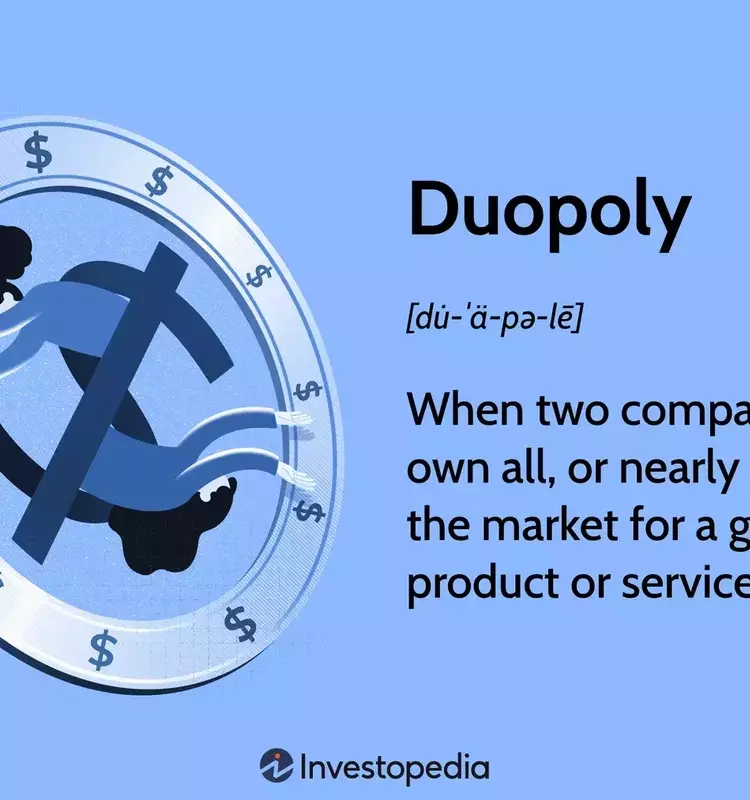
A duopoly refers to a market scenario where two firms control the vast majority of the supply for a specific product or service. This market structure, distinct from a monopoly (single seller) or an oligopoly (few sellers), creates a unique competitive dynamic influencing pricing, innovation, and consumer options. Prominent examples include the rivalry between Visa and Mastercard in payment processing, or Coca-Cola and Pepsi in the beverage industry.

In a duopoly, the two dominant enterprises exert significant influence over their respective market segments, even if their overall operations span other unrelated sectors. For instance, while Google and Meta (formerly Facebook) largely control the digital advertising landscape, their business interests extend beyond this specific duopoly. The inherent competition between these two key players generally helps to keep prices in check, preventing them from escalating to monopoly levels. However, the limited number of major players also raises the possibility of market consolidation, either through one firm acquiring the other or through collusive agreements that could artificially inflate prices and reduce consumer benefits. Such collusive practices are strictly prohibited under antitrust laws to safeguard fair competition.

Duopolies present a mixed bag of economic effects. On the positive side, the intense competition between the two firms can drive continuous product improvement. With limited external threats, these companies can focus their resources on enhancing existing offerings. This rivalry can also serve as a natural price regulator, ensuring that consumers don't face the inflated costs typical of a monopoly. However, the restrictive nature of a duopoly can stifle innovation from new market entrants and limit consumer choice. The potential for price-fixing and other forms of collusion between the two dominant players remains a significant concern, as such actions can lead to higher prices and fewer alternatives for consumers.

Duopolies, characterized by the dominance of two firms in a specific market, present a double-edged sword: they can foster competitive innovation and moderate pricing due to direct rivalry, yet they also pose risks of market stagnation and anti-consumer practices if collaboration replaces competition. Understanding these dynamics is crucial for grasping how market structures impact both businesses and consumers.

More Articles
Finance
Karyopharm Therapeutics Faces Headwinds: Downgraded to 'Hold' Amid Sales Struggles and Regulatory Challenges
Karyopharm Therapeutics (KPTI) has been downgraded to 'Hold' from 'Strong Buy' due to disappointing XPOVIO sales and regulatory hurdles. The company projects 2026 U.S. XPOVIO sales between $115–$130 million, facing increasing competition in multiple myeloma. The FDA rejected the sNDA for selinexor in endometrial cancer, though a new Phase 3 trial is underway. Mixed results from the Phase 3 SENTRY trial for myelofibrosis also add to the uncertainty.
By Michele FerreroJul 21, 2026
Finance
Sequoia Fund's Q2 2026 Performance and Strategic Reorganization Towards an Actively Managed ETF
The Sequoia Fund reported an 11.67% total return in Q2 2026, trailing the S&P 500 Index's 15.20%. Year-to-date, the fund experienced a negative 0.64% return against the Index's 10.21%. The fund strategically adjusted its portfolio by increasing stakes in Bio-Techne, SAP, and ICON Plc, while reducing positions in Sunbelt Rentals and Elevance Health, and fully divesting from Amentum Holdings, Liberty Broadband, and Credit Acceptance Corp. Plans are underway to reorganize the mutual fund into an actively managed ETF, pending a shareholder vote on July 27, 2026, with an anticipated conversion in mid-October. Shareholders are required to transfer direct holdings to an eligible brokerage account by September 15, 2026.
By Strive MasiyiwaJul 21, 2026
Finance
Understanding Delta: A Key Options Metric in Financial Trading
Delta is a crucial risk metric in options trading, quantifying how a derivative's price responds to a $1 change in its underlying asset. It's used by traders to assess market sensitivity, predict price movements, and implement hedging strategies. This article explores the mechanics of delta, its application to call and put options, and its role in managing portfolio risk, offering valuable insights for both seasoned investors and beginners.
By Suze OrmanJul 21, 2026
Finance
Microsoft's AI-Driven Transformation: A Misunderstood Opportunity
Microsoft Corporation is undergoing a significant transformation, shifting its monetization strategy from traditional software subscriptions to AI-driven consumption models. Despite concerns over record capital expenditures in AI, these investments are backed by strong demand, particularly for Azure capacity. The rapid adoption of Copilot and GitHub Copilot underscores a successful pivot towards scalable, recurring revenue, strengthening enterprise integration. With an attractive valuation and projected EPS growth, Microsoft presents a compelling risk/reward profile.
By Robert KiyosakiJul 21, 2026
Finance
Understanding Gifts of Equity in Real Estate Transactions
A gift of equity allows homeowners to sell property to family members below market value, making homeownership more accessible by reducing or eliminating the need for a down payment. This strategy, common between relatives, impacts mortgage qualification, potential tax liabilities, and future capital gains, requiring careful consideration and proper documentation.
By Michele FerreroJul 21, 2026