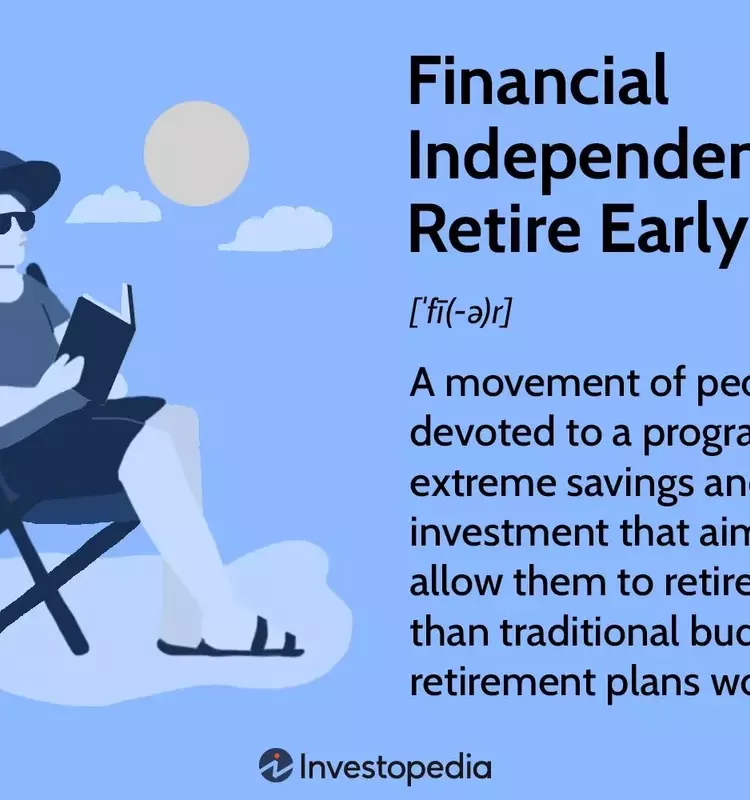
Understanding the FIRE Movement: Financial Independence, Retire Early
Finance

Understanding the FIRE Movement: Financial Independence, Retire Early

authorBy Robert Kiyosaki
DateApr 28, 2026
Read time2 min

The Financial Independence, Retire Early (FIRE) movement is a financial strategy focused on extreme savings and strategic investments, with the ultimate goal of achieving retirement much earlier than the conventional age or simply gaining substantial financial flexibility. This philosophy gained significant traction after the publication of "Your Money or Your Life" by Vicki Robin and Joe Dominguez in 1992, which challenged individuals to reconsider the true cost of their expenditures in terms of their earned working hours.

Achieving the goals of the FIRE movement involves a meticulous approach to personal finance. Participants typically work diligently for several years, dedicating a substantial portion—often up to 75%—of their annual income to savings and investments. The key milestone, often referred to as the "FIRE number," is generally calculated as 25 times their anticipated yearly expenses. Upon reaching this financial benchmark, individuals may choose to leave their conventional employment entirely or transition to part-time work, drawing down a modest 3% to 4% of their accumulated savings annually, adjusted for inflation, to cover living costs. This framework supports various lifestyles, from the affluent "Fat FIRE" to the minimalist "Lean FIRE," and even "Barista FIRE," which combines part-time work with savings.

While the concept of early retirement is appealing, its practical attainment remains a challenge for many. Statistics indicate that only a small fraction of individuals manage to retire significantly before the average retirement ages of 63 for women and 65 for men. For those considering this path, thorough planning is essential. It includes building a robust emergency fund equivalent to three to six months of expenses and making judicious investment decisions. Maximizing contributions to employer-sponsored retirement plans and individual retirement accounts (IRAs) is crucial. It is also important to regularly reassess your FIRE number, as the sustainability of a 4% withdrawal rate, particularly for extended retirement periods, is often debated among financial experts. Additionally, be mindful of early withdrawal penalties from retirement accounts if accessing funds before age 59½.

The FIRE movement offers a transformative perspective on personal finance, emphasizing conscious spending, aggressive saving, and strategic investing to achieve a life of greater freedom and purpose. Embracing this philosophy allows individuals to align their financial decisions with their life aspirations, fostering a proactive approach to financial well-being. By prioritizing financial independence, you can create a life where your choices are driven by passion rather than necessity, leading to a more fulfilling and empowered existence.

More Articles
Finance
Kohl's Financial Outlook: Tariff Refunds and Market Challenges
Kohl's is projected to receive a significant tariff refund, potentially bolstering its financial position by hundreds of millions of dollars after taxes. Despite this positive development, the company faces potential headwinds from global geopolitical events, which could impact its sales performance and push financial results towards the lower end of its guidance. Even with a conservative sales forecast and slightly reduced gross margins, Kohl's is anticipated to substantially increase its cash reserves.
By Suze OrmanApr 28, 2026
Finance
Clorox: Opportunity for Growth and Value
Clorox is positioned for future growth despite recent underperformance. With a compelling dividend yield and strategic acquisitions like Purell, the company is expected to see normalized operations and double-digit earnings growth. Its valuation suggests significant upside potential compared to competitors, making it an attractive investment.
By Morgan HouselApr 28, 2026
Finance
Understanding Account Analysis in Finance
Account analysis is the detailed examination of financial transactions within an account to assess its performance, identify trends, and ensure accuracy. This process is crucial in both accounting and banking, helping stakeholders make informed decisions.
By Fareed ZakariaApr 28, 2026
Finance
Lowe's Shares Approaching Fair Valuation Amid Housing Sector Headwinds
Lowe's has seen a modest 9% gain in its stock over the past year, despite facing challenges from a subdued construction market and reduced DIY demand. While recent acquisitions have bolstered its professional segment, overall construction activity, especially in oversupplied Sun Belt regions, remains weak. The company's 2024 forecast predicts 7%-9% sales growth, largely due to M&A, but expects stagnant earnings per share and margin pressures. With shares nearing fair value, the rating has been updated to 'Hold', suggesting no immediate compelling reason to invest above $210.
By Morgan HouselApr 28, 2026
Finance
The Misery Index: A Comprehensive Economic Indicator
The Misery Index is an economic metric that combines unemployment and inflation rates to gauge the financial stress experienced by citizens. Developed by Arthur Okun in the 1970s during a period of stagflation, it offers a quick overview of economic health. A higher index signifies increased public discomfort. While insightful, it has limitations, such as not accounting for economic growth or the nuances of unemployment and inflation impacts, leading to several modernized versions.
By David RubensteinApr 28, 2026