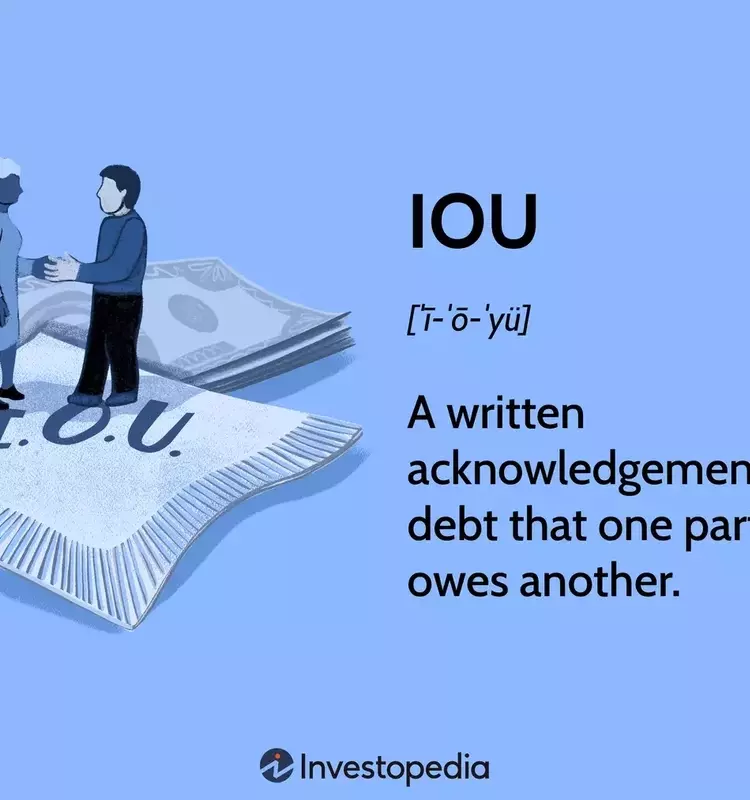
In the realm of financial arrangements, IOUs serve as an informal yet widely recognized method of acknowledging a debt. These documents, derived from the phrase "I owe you," are simple written statements confirming a borrower's obligation to a lender. While they have been in use for centuries, their informal nature means they often lack the detailed terms and legal enforceability found in more formal agreements like promissory notes. Businesses and individuals frequently employ IOUs as an initial record of debt, paving the way for more comprehensive contracts later on.
The Nature and Function of IOUs
An IOU, essentially an informal debt acknowledgment, originates from the phonetic representation of "I owe you." Its usage dates back to the 18th century, offering a less formal alternative to legally binding contracts. Although IOUs document debt, their lack of formality often leads to interpretive ambiguity and limited enforceability compared to official agreements. Both individuals and businesses commonly use IOUs as a provisional arrangement, often preceding the drafting of more elaborate contracts.
IOUs are typically created spontaneously, such as during business meetings, acting as a preliminary record of intent. These informal agreements often precede formal contracts. While IOUs lack a standardized format, essential information should include the date, debt amount, repayment deadline, identities of the involved parties, and the borrower's signature. However, they frequently omit details such as interest rates, payment methods, or consequences for nonpayment. Due to their informal nature, IOUs may not be legally binding or carry significant weight in court. Consequently, enforcing repayment through legal means can be more challenging with an IOU compared to formal debt agreements like promissory notes or bond indentures. Because of this uncertainty, an IOU is generally not a negotiable instrument and cannot be easily sold, transferred, or traded. Nonetheless, various templates are available online to assist in creating more detailed IOUs, potentially enhancing their enforceability in legal settings.
Consider a scenario where Smithco Bricks orders raw materials but lacks immediate funds for the full payment. They might make a down payment and issue an IOU, pledging to settle the remaining balance, with or without interest, within 30 days. Given an established business relationship with the supplier, this arrangement could be mutually acceptable. Importantly, IOUs also find application in other financial contexts, such as representing bond issues or accounts receivable. A bookkeeper might categorize an outstanding debt as an IOU, listing it as an accounts receivable asset on the balance sheet. If the debt is due within a year, it's a current asset; if repayment extends beyond a year, it becomes a long-term asset.
IOUs Versus Promissory Notes: A Comparative Insight
IOUs and promissory notes share fundamental similarities as written financial agreements addressing debt, specifically the promise of one party to repay a specified sum to another by a certain date. However, promissory notes are distinguished by their greater formality and comprehensiveness. A promissory note not only specifies a repayment due date but typically details the loan's interest rate, payment schedule, repayment amounts, and often penalties for late or missed payments. The term "promissory note" must be explicitly stated within the document. Both the lender and borrower sign the note, and it is frequently witnessed and notarized.
In essence, promissory notes are more precise and serious instruments than IOUs. While still less formal and enforceable than a full loan agreement or contract, they generally hold up better in court. Indeed, promissory notes often accompany mortgage and student loan agreements, obligating the borrower to repayment. If the terms are sufficiently unconditional, promissory notes can even serve as negotiable instruments. It is crucial for issuers of promissory notes to be aware that the statute of limitations for filing a lawsuit due to nonpayment is determined by local state laws, typically ranging from three to fifteen years. The clock begins ticking from the date of the initial breach. However, some courts have ruled that for each missed payment within a note, a separate statute of limitations commences on the date that specific payment became overdue.
Crafting an IOU can take various forms, from typed documents to handwritten notes, and can be prepared by either party on any available medium. At a minimum, an IOU should include the borrower's name, the lender's name, the debt amount, the current date, the repayment due date, and the borrower's signature. For enhanced enforceability, it is advisable to also include: the method of repayment (lump sum or installments), a repayment schedule (detailing payment size and frequency for installments), whether interest is charged and at what rate, any guarantor for the debt, and the state laws governing the agreement. The lender's signature is also recommended. Online resources increasingly offer IOU forms and templates to facilitate the creation of such documents.
An IOU is a written, though informal, acknowledgment of debt between two parties, specifying the amount owed by the borrower to the lender. Signed by the borrower, it often includes a repayment date but frequently omits other specifics like payment schedules or interest charges. It typically cannot be sold or transferred and offers limited legal recourse to the lender if not honored. For instance, if Amanda T. lends her friend Karen P. $1,500 for a security deposit, and Karen promises to repay it by April 1, 2025, Karen signs a document affirming this debt, thus creating an IOU. While an IOU is a legal document admissible in court, its binding nature remains debatable. Some legal experts consider it merely an acknowledgment of debt, while others view it as binding, though enforceability can vary. Generally, the more detailed an IOU, the more likely it is to be enforceable. Conversely, fewer specifics make it harder for a court to ascertain obligations, rights, or even the identities of the involved parties. Notarization is not mandatory for an IOU, but some legal professionals believe it lends more official status and increases enforceability, making it more akin to a promissory note.
IOUs, as written yet relatively informal agreements, document a debt and a commitment to repay. They typically cover the core aspects of the arrangement but often lack detailed terms or repayment schedules, which limits their legal binding force and enforceability compared to more formal, witnessed, or notarized contracts. Commonly used for smaller sums between individuals, IOUs are also employed by businesses, particularly between entities with established, ongoing relationships, such as vendors and suppliers. In such cases, an IOU effectively functions as a short-term loan or a credit purchase, wherein the company pledges to pay for goods or services at a later date. Accountants may record any outstanding debt as an IOU, and some bookkeeping systems even classify all accounts receivable as IOUs.
Reflections on Financial Commitments: The Role of Trust and Formality
This exploration into IOUs and promissory notes underscores the intricate balance between trust and legal formality in financial dealings. As society increasingly digitizes, the reliance on informal agreements like IOUs might seem archaic, yet they persist due to their simplicity and the foundational trust they represent in personal and established business relationships. However, the nuances highlighted in this article serve as a crucial reminder: while trust forms the bedrock, especially in informal lending, a lack of clear, detailed, and legally robust documentation can expose parties to significant risks. The comparison vividly illustrates that opting for a promissory note, with its defined terms and legal safeguards, not only protects the interests of both the lender and the borrower but also fosters greater clarity and accountability. Moving forward, individuals and businesses should weigh the convenience of informality against the imperative of legal protection, ensuring that their financial arrangements are not just acknowledged but are also securely enforceable, thereby mitigating potential disputes and safeguarding their financial well-being.
