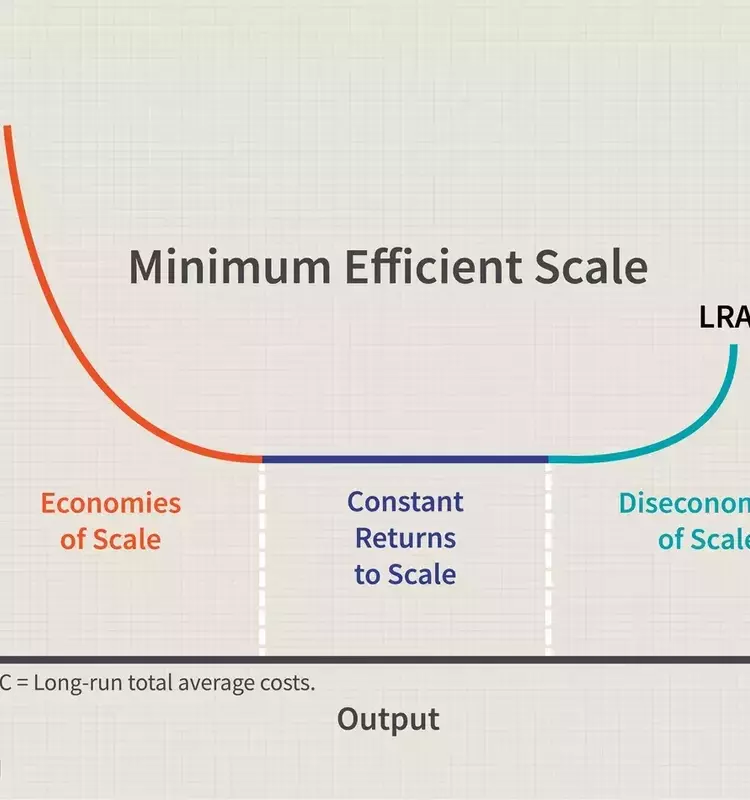
Minimum Efficient Scale (MES) is a pivotal economic concept for businesses, denoting the production threshold at which a company's per-unit production cost is minimized, thereby enhancing its market competitiveness. This optimal point requires a strategic balance among consumer demand, production volume, and the expenditures on labor and raw materials. Attaining MES is predominantly driven by economies of scale, a phenomenon where larger production volumes result in lower average costs per unit. This can stem from internal operational enhancements or broader industry-wide changes. While MES is critical for cost optimization, it eventually transitions into a phase of constant returns, beyond which further increases in production do not contribute to additional cost reductions.
For any entity involved in manufacturing, identifying the precise balance between market demand, output quantity, and the associated production expenses is paramount. The Minimum Efficient Scale represents the output level where the long-run average total cost (LRATC) is at its lowest. LRATC encompasses the average cost per unit over an extended period, assuming all inputs are variable. MES empowers a firm to produce goods at the most economical per-unit cost, sustaining this efficiency until the point of constant returns to scale is reached. The feasibility for competitors to thrive within a market is directly influenced by the MES, as it dictates the minimum cost-efficient production necessary for effective market participation.
The concept of economies of scale is intricately linked to MES. It signifies the advantage a company gains by reducing per-unit costs as production volume increases. This spreading of total costs over a larger output enhances efficiency and profitability, enabling the company to offer more competitive pricing. Economies of scale can be categorized into internal and external. Internal economies are realized through a firm's own strategic initiatives, such as process improvements or technological upgrades. A classic illustration is Henry Ford's implementation of the assembly line, which segmented tasks and utilized less-skilled labor, thereby increasing output and reducing per-unit costs. Conversely, external economies of scale arise from industry-wide factors, like government incentives or advancements benefiting all players in a sector. Beyond MES, firms might encounter diseconomies of scale, where increasing complexity and size lead to higher average costs due to management inefficiencies or communication breakdowns.
Consider the case of a mobile device manufacturer, XYZ Company, aiming to boost revenue while cutting production costs. By investing in advanced machinery, XYZ Company enhanced its production capacity and speed, leading to a significant reduction in the long-run average cost per unit. This technological upgrade also improved resource utilization, requiring fewer raw materials per device. Despite the initial capital outlay, the company achieved higher profitability through internal economies of scale, managing increased sales volumes and securing bulk discounts on raw materials. This strategic move allowed XYZ to lower variable costs and further reduce the average cost per unit. Ultimately, the company reached its Minimum Efficient Scale; beyond this point, additional production no longer generated further cost savings, signifying the onset of constant returns to scale and the full realization of internal efficiency gains.
Achieving the Minimum Efficient Scale is paramount for businesses to ensure competitive pricing and maximize profitability. It is the optimal production level where per-unit costs are at their lowest, utilizing the full benefits of economies of scale. However, MES is not a static target; it requires continuous monitoring and adaptation due to shifting market dynamics, including labor costs, regulatory changes, and technological advancements. In industries demanding high production volumes to reach MES, such as telecommunications, fewer but larger players tend to dominate. Conversely, sectors like the restaurant industry, with lower MES requirements, can accommodate a greater number of efficient competitors. Therefore, a firm's ability to regularly reassess and adjust its production strategies in response to evolving external variables is crucial for maintaining its competitive edge and optimizing its long-run average total costs.
