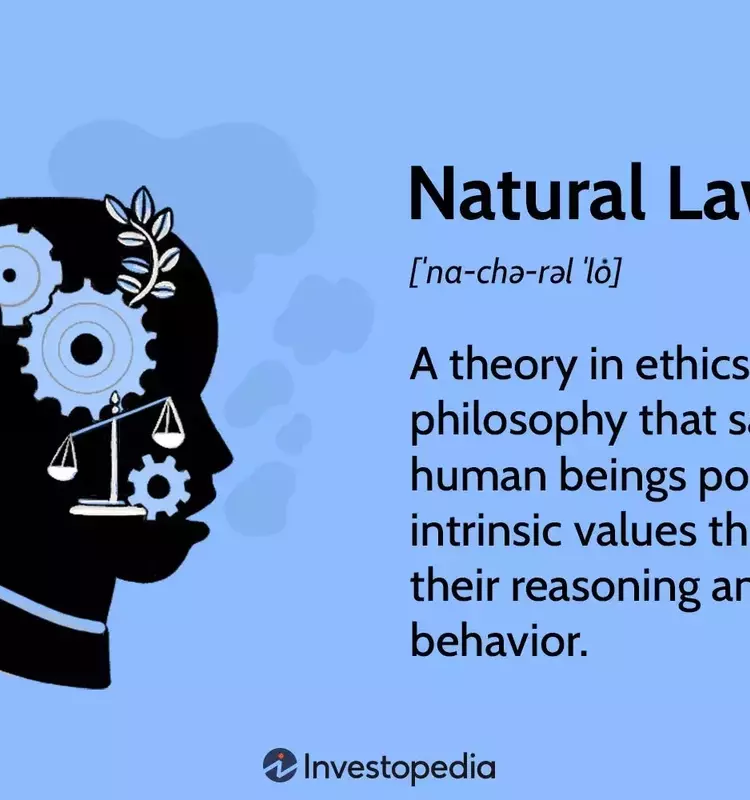
Natural law is a fundamental ethical theory asserting that inherent moral principles intrinsically guide human behavior. These universal values, which distinguish right from wrong, are not dictated by society or governmental decrees but are considered an intrinsic part of human nature. This concept suggests that everyone, regardless of their cultural, political, or religious background, possesses an innate understanding of these moral standards, which should serve as the bedrock of a just society. Natural law theory has significantly influenced various fields, from philosophy and religion to economics and legal systems, shaping how societies define justice, rights, and ethical conduct.
Natural law posits that ethical conduct is governed by universal, inherent principles, not by human-made laws or societal conventions. These principles are understood through human reasoning and are believed to be universally accepted across all cultures and times. While positive law is created and enforced by human authorities, natural law is seen as an intrinsic moral compass that guides individuals toward good and away from evil. This foundational idea has profound implications for how legal systems are structured, how economic theories are developed, and how individuals perceive their fundamental rights, such as life, liberty, and property.
The Core Tenets of Natural Law
Natural law theory centers on the idea that there are universal moral standards embedded within human nature, which are not explicitly taught but are discovered through consistent ethical decision-making. These inherent principles are believed to be divinely ordained or naturally occurring, serving as the basis for a just society. Unlike human-made laws that vary across cultures and political systems, natural law grants immutable rights to all individuals, including the rights to life, freedom, and ownership, which cannot be legitimately infringed upon by any authority. While human rights may differ based on societal views, natural law's birthrights remain constant, offering a timeless framework for ethical conduct.
This philosophical perspective maintains that ethical principles are ingrained in human beings, guiding their actions and judgments independently of external regulations. These inherent moral rules, which are discovered rather than taught, are considered to be foundational for a just society and are often seen as originating from a divine source. Adherents of natural law believe that every individual possesses fundamental rights, such as the rights to existence, autonomy, and possessions, which transcend governmental or societal dictates. These universal rights stand in contrast to human rights, which can be altered by political and cultural contexts, thus highlighting natural law's enduring and universally applicable nature.
Natural Law's Influence on Society and Thought
Natural law has significantly shaped various domains, from ancient philosophy to modern economic thought. Philosophers like Aristotle saw natural justice as an unchanging force, while figures such as St. Thomas Aquinas linked it intrinsically with divine eternal law, asserting that humanity's role is to pursue good and avoid evil. Leaders like Mahatma Gandhi highlighted natural law through his critique of societal "sins," advocating for ethical living guided by intrinsic principles. Similarly, Martin Luther King Jr. championed natural law in his call for civil disobedience against unjust human-made laws, emphasizing the moral imperative to uphold inherent human dignity. These diverse applications demonstrate how natural law provides a consistent framework for ethical and social commentary, underscoring universal moral truths that guide human existence and societal structure.
Throughout history, the concept of natural law has been a driving force in ethical and societal development, influencing a wide range of thinkers and disciplines. Aristotle laid early groundwork by distinguishing natural justice from legal statutes, positing universal ethical truths. St. Thomas Aquinas further integrated natural law with religious doctrine, viewing it as humanity's participation in divine order and advocating for the inherent pursuit of good. Beyond theological and philosophical realms, natural law has had practical implications, as seen in Mahatma Gandhi's moral challenges to societal failings and Martin Luther King Jr.'s arguments for upholding justice against oppressive laws. Economists, too, have implicitly drawn on natural law by recognizing inherent principles that govern economic interactions, such as Adam Smith's laws of self-interest, competition, and supply and demand. This pervasive influence underscores natural law's role as a timeless and universal guide for human behavior and societal organization.
