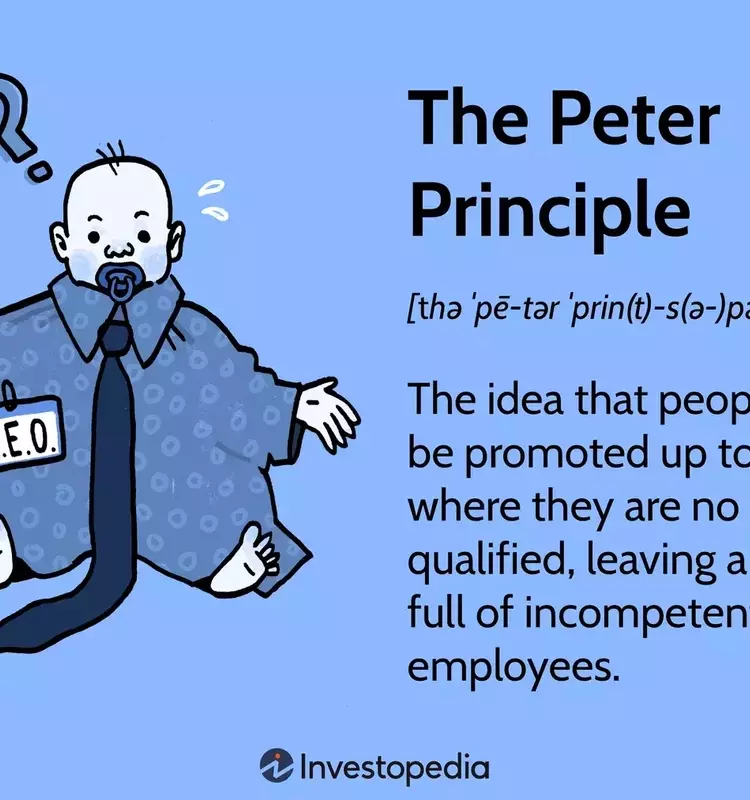
This essay explores the Peter Principle, a concept suggesting that employees are promoted within an organizational structure until they reach a level where they are no longer competent. This phenomenon arises because promotions are often based on past performance rather than suitability for new responsibilities, leading to various issues like reduced productivity, low morale, and ineffective leadership within companies. We will also touch upon strategies to counteract this principle, emphasizing the importance of appropriate training and skill assessment for promotion candidates.
The Peter Principle, conceptualized by Canadian educational scholar and sociologist Dr. Laurence J. Peter in his 1968 publication, posits that individuals within hierarchical systems advance by being rewarded for their current competence. However, this advancement continues until they occupy a role where their existing skills no longer suffice for effective performance. Dr. Peter suggested that this new incompetence is not due to a general lack of ability, but rather a mismatch between their established skill set and the demands of the new position. For instance, an engineer excelling in technical tasks might be promoted to a managerial role without possessing the necessary leadership or interpersonal skills. This often results in them becoming ineffective in their new capacity.
This theory effectively rephrased the common saying, "The cream rises to the top," by adding a critical caveat: "The cream rises until it sours." This implies that an employee's success in one role eventually leads to their placement in a role where they can no longer perform satisfactorily. A key aspect of the Peter Principle is the observation that employees, once they reach this level of incompetence, tend to remain in those positions. This is largely because mere incompetence is rarely a sufficient reason for termination, especially if their previous performance was exemplary. This can create a perpetual cycle of underperforming managers who are entrenched in their roles, hindering overall organizational efficiency.
The ramifications of the Peter Principle extend significantly to organizational productivity and employee morale. When managers are ill-equipped for their roles, they struggle to provide clear direction, effective supervision, and quality control. This deficiency in leadership can lead to an increase in errors and a decline in the quality of work performed by their subordinates. The problem can become systemic, as lower-level employees who are competent in their operational tasks may also be promoted, creating multiple layers of management lacking the essential skills for their positions. Such a situation fosters an environment of frustration and dissatisfaction among employees, who may feel unsupported or poorly led, ultimately damaging morale and engagement across the organization.
In 2018, economists Alan Benson, Danielle Li, and Kelly Shue conducted a study analyzing sales employees' performance and promotion practices in 214 American businesses. Their findings corroborated the Peter Principle, revealing that promotions to management were predominantly based on prior sales performance, rather than an assessment of managerial potential. This study underscored the inherent flaw in promoting individuals solely based on their success in a non-managerial capacity, often overlooking the distinct skill sets required for leadership roles. Their research highlighted that high-performing sales personnel, once promoted to management, frequently exhibited poor performance, leading to substantial costs for the businesses involved. These costs stemmed from decreased team efficiency, higher error rates, and the broader impact on organizational objectives. The study served as an empirical validation of Dr. Peter's theory, demonstrating its tangible consequences in real-world business environments.
The Peter Principle highlights a significant challenge in organizational design: the tendency to elevate individuals to positions where their previous successes do not guarantee future competence. This often leads to a workforce with ineffective leadership, diminished output, and low morale. To counteract this, organizations must shift their focus from solely rewarding past performance to meticulously evaluating potential candidates' suitability for new roles, implementing rigorous training, and cultivating a culture that values diverse skill sets beyond initial job functions.
