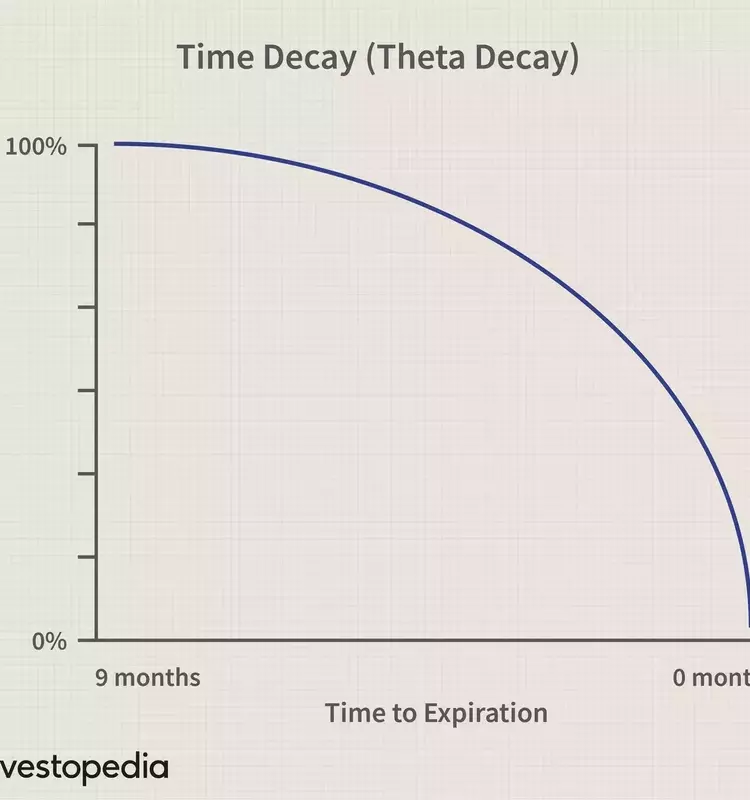
Options trading is a complex field where various elements influence an option's worth. Among these, the concept of "time decay," or "theta," stands out as a fundamental aspect. It signifies the gradual reduction in an option's value as its expiration date approaches. This process is not linear; it intensifies as the deadline nears, particularly in the final month. For traders, a solid grasp of time decay is essential for evaluating potential returns and managing associated risks.
The Intricacies of Time Decay in Options
Time decay is a continuous decrease in an option's value as its expiry date draws closer. This reduction primarily affects the option's "time value," which represents the influence of time on its premium. As time progresses, the opportunity for an option to become profitable diminishes, leading to an accelerated erosion of its time value. This inherent characteristic means that the calculated time decay figure will always be negative, reflecting the one-way passage of time. The countdown of time decay begins the moment an option contract is established and concludes only upon its expiration.
Several factors contribute to an option's overall value. At its core, an option grants the holder the right to buy or sell an underlying asset, such as a stock, at a predetermined "strike price" by a specific date. The price of an option, known as its "premium," is influenced by its intrinsic value, extrinsic value, prevailing interest rates, and the expected volatility of the underlying asset.
Intrinsic value is the immediate profit an option offers. For instance, a call option with a strike price of $20, when the underlying stock is trading at $30, has an intrinsic value of $10. This value fluctuates with the stock's market price, but the strike price remains constant throughout the contract's life. In contrast, extrinsic value is a more abstract component, heavily influenced by the time remaining until expiration and the rate of time decay. Options with longer durations until expiry typically possess greater extrinsic value, as there's more time for favorable market movements. However, as the expiration date approaches, especially within the last 30 days, the extrinsic value declines rapidly, particularly if the option hasn't yet become profitable. This phenomenon highlights options as "wasting assets," meaning their value inherently decreases over time.
Comparing options based on their "moneyness" further illustrates the impact of time decay. Options that are "in-the-money" (ITM), meaning they are already profitable, retain more value as expiration nears because their profit is already locked in. For these options, time is a less critical factor, and time decay occurs at a slower pace. However, for "at-the-money" (ATM) and "out-of-the-money" (OTM) options, where there is little to no intrinsic value, time decay plays a much more significant role. The premium of an ATM option consists almost entirely of time value, and for OTM options, time decay accelerates even faster as the probability of becoming profitable diminishes with each passing day.
Strategic Implications for Traders
For options traders, understanding time decay is not merely an academic exercise; it's a practical necessity. Traders often leverage time decay in their strategies, buying options with ample time until expiry to benefit from slower decay rates or selling options closer to expiry to capitalize on accelerated decay. For example, an investor considering a call option might choose one with two months until expiration and a $2 premium, expecting the stock to rise. However, a similar option with only a week left might cost just 50 cents, reflecting the steep time decay and the reduced likelihood of significant price movement in such a short period. This stark difference in premiums underscores the importance of extrinsic value and time decay in options pricing.
In conclusion, time decay is an inescapable force in options trading, systematically eroding an option's extrinsic value as its expiration approaches. This decay is particularly pronounced as the expiration date draws near. By thoroughly understanding how time decay interacts with intrinsic and extrinsic values, traders can develop more robust strategies, manage their risk exposure more effectively, and ultimately enhance their potential for success in the dynamic options market.
